 Login with Google
 Signin with Apple
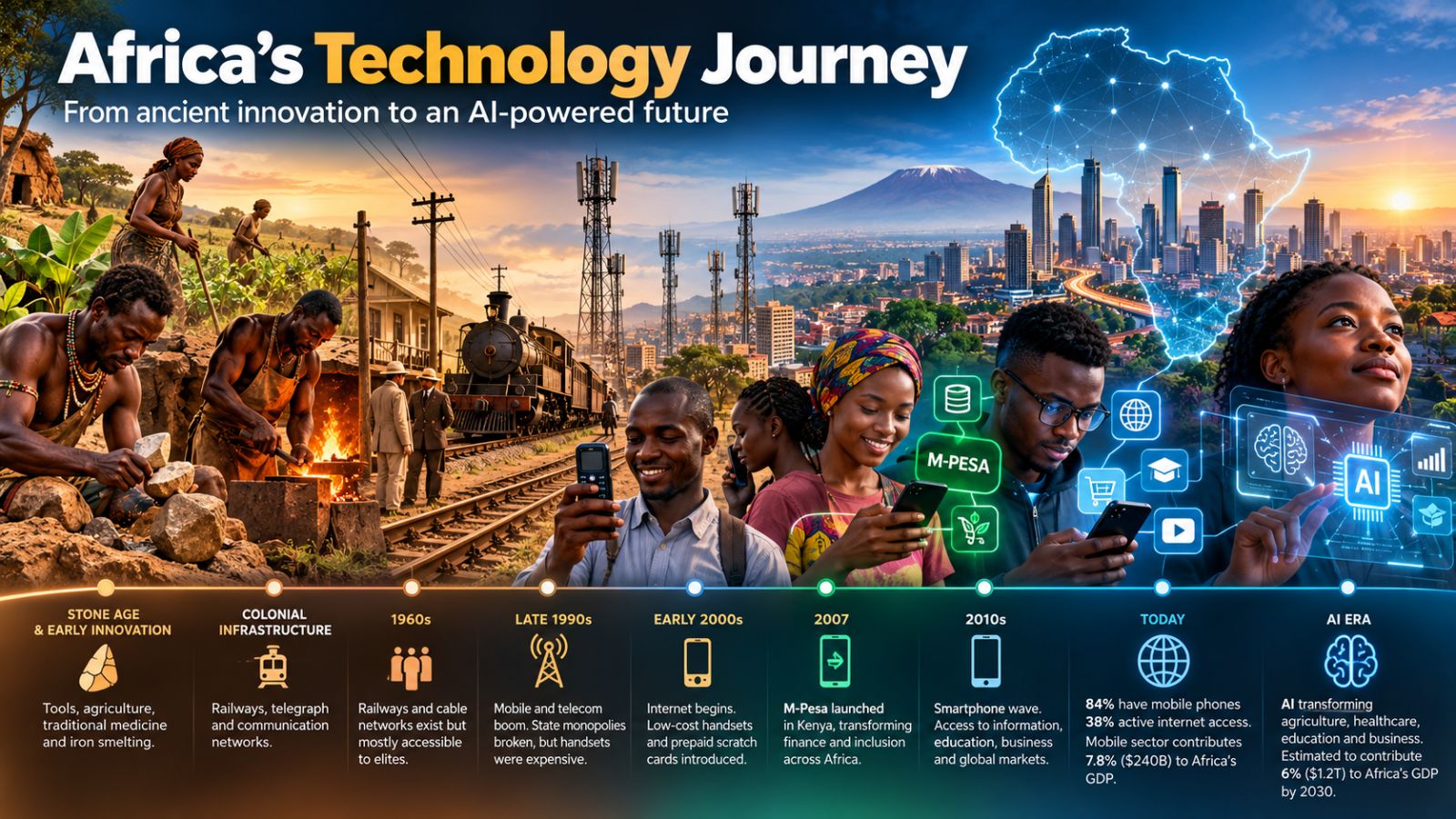
From Stone Tools to Artificial Intelligence: Africa’s Technology Journey and the Road Ahead
Simon Njuguna Muchiri , Kenya Oct 26, 2026
1. Africa Has Always Been Technological
When we talk about technology in Africa, the conversation often begins with smartphones, the internet or artificial intelligence. But Africa’s technological journey began long before these inventions existed.
During the Stone Age, early African communities developed tools that helped them hunt, cultivate land and adapt to their environments. Over centuries, communities developed complex agricultural systems, traditional medicine, metalworking and iron-smelting techniques. These were not merely survival mechanisms; they were technologies shaped by generations of observation, experimentation and knowledge.
Africa was never a continent without technology. It was a continent where technology evolved according to the needs, resources and knowledge of its people.
The colonial period introduced another layer of technological infrastructure. Railways, telegraph lines and other communication networks connected territories, cities and commercial centres. However, access to these systems was unequal. Much of the infrastructure served colonial administration, trade and extraction, while ordinary Africans had limited access to the services it enabled.
At independence in the 1960s, several African countries inherited railway networks and communication infrastructure. Yet owning infrastructure was not the same as making technology accessible. Access remained constrained by cost, geography, education and the concentration of services in urban centres.
This distinction would define much of Africa’s technological journey: the real breakthrough would not simply be inventing or importing technology, but making it accessible to ordinary people.
2. The Mobile Revolution: Connecting the Unconnected
The late 1990s marked a turning point. Telecommunications began expanding across the continent as mobile networks emerged and many countries liberalised their telecommunications sectors.
Companies such as Safaricom in Kenya, MTN in several African markets and Celtel expanded mobile services into populations that traditional telecommunications infrastructure had struggled to reach.
But there was a problem: affordability.
Early mobile phones were expensive luxury items, beyond the reach of most households. Network coverage was also limited, and the cost of calls could be prohibitive. The technology existed, but mass adoption remained a distant goal.
Operators gradually introduced prepaid services, more affordable handsets and flexible payment options. Instead of requiring customers to commit to expensive monthly subscriptions, prepaid scratch cards allowed people to purchase airtime according to their budgets.
This seemingly simple change helped reshape the market. People did not need to be wealthy to communicate. They needed a handset, network coverage and enough money to purchase airtime.
The results were remarkable. Mobile subscriptions expanded rapidly during the 2000s, transforming communication, commerce and social interaction across Africa.
Then came an innovation that would change the relationship between technology and money.
3. Kenya and the Mobile Money Breakthrough
In 2007, Safaricom launched M-Pesa in Kenya.
At the time, sending money over long distances could be difficult, expensive and unreliable, especially for people without access to formal banking services. M-Pesa used mobile phones to make it possible to transfer money, purchase services and conduct transactions without requiring a conventional bank account.
Its significance went far beyond convenience.
Small businesses could receive payments. Families could send money to relatives in rural areas. Workers could transfer earnings home. People previously excluded from formal financial systems gained new ways to participate in the economy.
Mobile money demonstrated something important: Africa did not always need to follow the same technological path as wealthier economies.
Rather than waiting for every community to develop a comprehensive network of physical bank branches, mobile technology enabled financial services to reach people through an existing and increasingly widespread device.
This was not simply the adoption of foreign technology. It was the development of a solution that responded to a distinctly local challenge and eventually attracted international attention.
M-Pesa showed that the most transformative technologies are often those that solve everyday problems at scale.
4. Smartphones: The Missing Link
By the late 2000s and into the 2010s, smartphones began changing what mobile technology could do.
A basic phone allowed people to communicate. A smartphone could connect them to information, education, entertainment, financial services, business tools and global markets.
It combined several technologies into one device: a camera, computer, navigation system, communication tool and gateway to the internet.
As lower-cost smartphones entered the market, more Africans gained access to digital services without needing to purchase a desktop computer or establish a fixed internet connection.
The consequences were significant.
A small business owner could advertise products on social media. A student could access educational materials online. A farmer could search for market prices. A freelancer could work with clients in another country. A young entrepreneur could build a digital business using little more than a phone and an internet connection.
The smartphone became more than a communication device. It became an entry point into the digital economy.
Yet the digital divide did not disappear. Many people still faced expensive data, unreliable electricity, poor network coverage and limited digital skills. Access to a smartphone did not automatically mean access to affordable, reliable internet.
Nevertheless, the direction was clear: technology was moving closer to ordinary people.
5. The AI Era: Another Turning Point
Today, Africa is entering another technological transition: the era of artificial intelligence.
AI is different from previous technological waves because it does not merely connect people or provide access to information. It can help people analyse information, generate ideas, automate repetitive tasks, solve problems and make decisions.
A smartphone placed the internet in someone's hands. AI can help that person do more with the information and tools available to them.
Consider a farmer who uses AI to identify a crop disease, a teacher who uses it to analyse student performance, or a small business owner who uses it to organise financial records. A fabricator can use AI to develop equipment designs, while a data steward can use it to clean spreadsheets, identify inconsistencies and integrate records into a master database.
These are not just possibilities for large technology companies. They are practical applications for people working in agriculture, education, healthcare, manufacturing and small businesses.
Kenya is particularly interesting in this transition. Its experience with mobile money, digital payments and technology-driven entrepreneurship provides a foundation on which AI applications can develop. Other countries, including South Africa, Rwanda, Nigeria, Egypt and Morocco, are also investing in digital capabilities and exploring AI applications.
Across the continent, AI is being explored for agricultural advisory services, medical support, language processing, education and business operations.
The opportunity is substantial. Some projections suggest that AI could contribute around $1.2 trillion to Africa's economy by 2030. Such estimates should be treated as projections rather than guaranteed outcomes, but they illustrate the scale of the opportunity being discussed.
The question is no longer whether AI will influence Africa. It is how deeply it will become integrated into everyday economic and social life.
6. Africa Must Build AI for African Problems
For AI to deliver meaningful value, it must address problems that African communities actually face.
Agriculture provides a clear example. Farmers need timely information about weather, pests, soil conditions, crop diseases and market prices. AI tools designed for local crops, farming conditions and languages could help make such information more accessible.
Healthcare presents another opportunity. AI-assisted systems could support health workers with information management, preliminary analysis and resource planning, provided they are appropriately validated and used with proper clinical oversight.
Language is equally important. Africa's linguistic diversity presents both a challenge and an opportunity. AI systems that understand African languages and local expressions could make digital services more accessible to people who are poorly served by tools designed primarily for English and other widely represented languages.
Small businesses could also benefit. Many operate with handwritten records, informal bookkeeping and limited access to professional services. AI could help them organise transactions, analyse sales, forecast demand and improve record keeping without requiring expensive software or specialist staff.
The most important measure of AI adoption should not be how many people have experimented with a chatbot. It should be whether people are using AI to improve productivity, increase incomes, expand access to services and solve persistent problems.
7. The Barriers Africa Must Overcome
Despite the opportunity, Africa faces significant obstacles.
Infrastructure remains fundamental. AI depends on electricity, connectivity, computing capacity and reliable digital systems. Where power is unreliable or internet access is expensive, even the most advanced AI application can remain impractical.
Affordability determines adoption. A tool may be technically available but still inaccessible to someone who cannot afford the data, device or subscription required to use it regularly.
Skills and talent matter. Africa needs people who can build, maintain, evaluate and govern AI systems, not only people who can use existing applications. When skilled professionals leave for better opportunities elsewhere, local institutions and businesses can struggle to retain the expertise required to develop homegrown solutions.
Data quality is another challenge. AI systems depend on data, yet many organisations struggle with incomplete records, inconsistent formats, limited digitisation and fragmented information systems. Poor-quality data can undermine otherwise promising AI projects.
Governance and data protection cannot be ignored. Organisations need clear rules on privacy, consent, accountability, security and the responsible use of AI. Poor governance can expose people to discrimination, misinformation, surveillance or misuse of personal information.
Finally, Africa must address the question of technological dependence. If the continent only consumes AI products developed elsewhere, it risks remaining dependent on external platforms, infrastructure, intellectual property and business priorities.
Adopting technology is important, but developing the capacity to shape it is equally important.
8. The Next Five Years: What Direction Will Africa Take?
Looking towards 2030, several possible developments deserve attention.
First, AI may become embedded in everyday tools rather than remaining a separate technology. Farmers, teachers, accountants, healthcare workers, mechanics and business owners may increasingly use AI through applications they already understand.
Second, local-language AI could widen access to digital services. If systems become more capable of understanding African languages and local contexts, more people could benefit without needing advanced technical skills or fluency in a dominant international language.
Third, African businesses may begin automating more of their routine operations. This could improve productivity, but it will also require workers to develop new skills and organisations to rethink how work is performed.
Fourth, demand for local computing infrastructure, data centres, energy and AI training could encourage new investment. Partnerships between African technology companies and global technology providers may help expand capacity, although the long-term benefits will depend on ownership, affordability, skills development and the value retained within African economies.
Finally, AI could influence how governments and institutions deliver services, allocate resources and analyse public information. The benefits will depend on data quality, transparency, safeguards and public trust.
None of these outcomes is guaranteed. Infrastructure investment may lag behind demand. AI tools may remain unaffordable for many communities. Skills shortages and weak governance could limit progress. The technology could also increase inequality if its benefits concentrate among those who already have resources and opportunities.
The next five years will therefore be shaped not only by technological advances, but by the decisions African countries make about access, investment, education, governance and local innovation.
9. From Technology Consumers to Technology Creators
Africa's history offers an important lesson: technology becomes transformative when people adapt it to their needs.
Traditional agricultural systems responded to local environments. Mobile money addressed barriers to financial inclusion. Smartphones expanded access to information and digital services.
AI now offers another opportunity to build on that history.
But the ambition should go beyond giving more people access to tools developed elsewhere. Africa needs to develop local talent, support research, improve data infrastructure, invest in reliable electricity and connectivity, and create an environment where entrepreneurs can build solutions for African markets.
It also needs to ask difficult questions. Who owns the data? Who controls the infrastructure? Who benefits economically? Are local languages and knowledge represented? Will AI expand opportunity, or will it reinforce existing inequalities?
The answers will help determine whether AI becomes another imported service or a foundation for locally driven technological development.
Conclusion: Only Time Will Tell
Africa's technological journey stretches from stone tools and iron smelting to railways, mobile networks, mobile money, smartphones and now artificial intelligence.
Each period has brought new opportunities, but also new barriers. The mobile revolution demonstrated that affordability and relevance can accelerate adoption on a massive scale. AI will require the same attention to accessibility, but it will also demand stronger infrastructure, better data, deeper technical skills and responsible governance.
By 2030, Africa could be using AI to transform agriculture, education, healthcare, manufacturing and small businesses. It could also find itself constrained by the same challenges that have limited earlier waves of technological progress.
The future will depend on what African governments, businesses, institutions and communities do today.
The question is not whether Africa will embrace AI. The question is whether Africa will simply use it, or help build, shape and own the technologies that define its future.
Only time will tell.
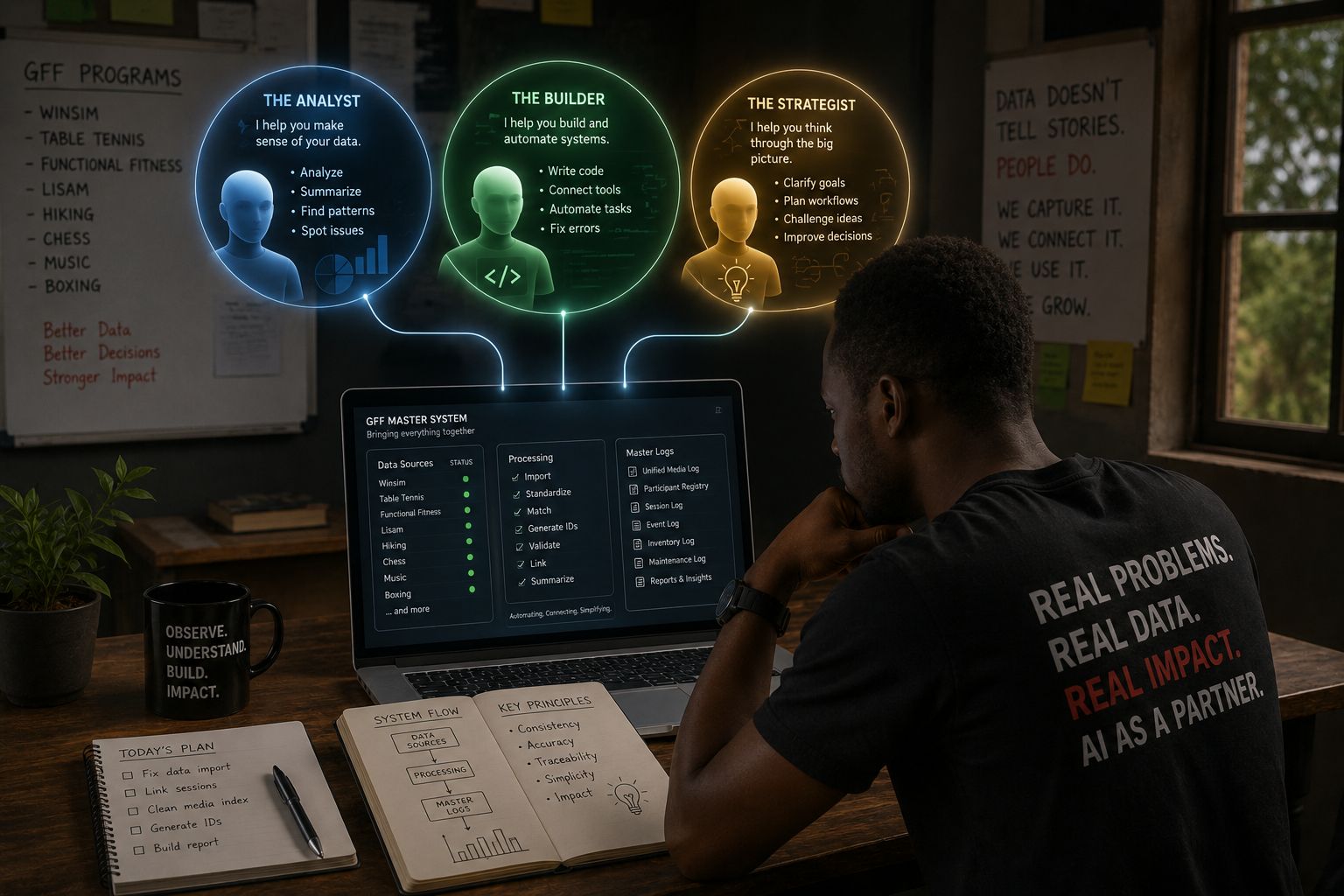
AI Is Good at Code. But It Still Doesn't Understand Your Organization
Simon Njuguna Muchiri , Kenya Aug 24, 2026
One of the biggest things I've learned from using AI at Global Fast Fit is that artificial intelligence can be extremely good at solving technical problems. But there's something it still doesn't automatically understand: the organization itself.
It can write code. It can suggest formulas. It can analyze data. It can explain Python. It can even help design a system. But it doesn't automatically know what that system means to the people using it.
The Difference Between a Technical Problem and a Real Problem
Suppose I tell AI: "I have several spreadsheets and I want to combine them into one master sheet." That sounds like a technical problem. AI can immediately suggest formulas, scripts, database structures, and different ways of importing information. But there are questions behind that request AI can't answer on its own.
Which spreadsheet is the authoritative source? Why are there several spreadsheets in the first place? Who enters the information? Why are the records structured differently? What happens when information is missing? Which fields actually matter? What should happen to an incorrect record? Who needs to use the final data?
Those aren't coding questions. They're organizational questions, and they require someone who understands what's actually happening on the ground.
AI Sees the Data. I See the Story Behind It.
When I work with GFF data, I know that a row is never just a row. There's usually a reason it exists. A participant record represents a person. A session represents an activity that actually happened. A video represents something that was recorded. An event represents people coming together. A piece of equipment represents something someone needs to use. A missing record may represent something that happened but was never properly documented.
AI can process the information I give it. But it doesn't automatically know the story behind that information — and that distinction became very important as I started building and connecting systems at GFF.
You Have to Teach AI Your Organization
The more complex the work became, the more context I had to provide. I had to explain what different programs were doing, what different columns meant, how sessions related to videos, how participants related to events, why certain IDs mattered, and what I considered a correct record. Only after providing that context could AI start giving me solutions that actually fit the organization.
That taught me something: AI doesn't arrive knowing your organization — you have to teach it. And the better you understand your own organization, the better you can use AI.
This Is Where Human Knowledge Becomes Valuable
There's sometimes a fear that AI will make human knowledge less important. My experience has actually made me think the opposite. The more capable AI becomes, the more valuable the person who understands the actual problem becomes.
If I know exactly what GFF needs, I can use AI very effectively. If I don't understand the organization, AI can produce a technically impressive solution that solves the wrong problem — and that can be worse than having no solution at all. A beautifully written script that does the wrong thing is still wrong.
I Learned This Through Trial and Error
My work with Apps Script taught me this repeatedly. I could ask ChatGPT to create a script, and it would look completely reasonable. Then I'd run it against the actual data and something wouldn't match — a row imported incorrectly, an ID generated in the wrong place, a record that didn't connect to the session I expected, an assumption that didn't match how our system actually worked.
At that point, I'd have to go back and explain the organization more clearly. The problem usually wasn't that the AI couldn't write the code. The problem was that I hadn't fully communicated the system. That was an important lesson.
Chess Gave Me Another Example
Chess provided another unexpected example. When we recently wanted to analyze tournament games stored in a PGN file, the technical task was relatively straightforward: read the PGN, extract the games, analyze the moves, produce useful information.
But even there, the interesting questions weren't purely technical. What do we actually want to learn from the games? Individual player performance? Blunders? Opening choices? Patterns across the tournament? How players made decisions? Those questions determine what the analysis should actually do. Python can process the PGN, and AI can help write the Python — but we have to decide what's worth analyzing.
AI Can Build the Tool. You Define the Purpose.
This has become one of my simplest ways of thinking about AI. It can help build the tool; humans have to define the purpose. It can help write the database query; humans have to decide what information matters. It can help write the Apps Script; humans have to decide what the workflow should be. It can help analyze the chess games; humans have to decide what they want to learn from them. That relationship works very well when both sides are doing what they're good at.
Context Is Everything
I've also learned that the quality of the answer I get from AI depends heavily on the quality of the context I provide. A vague description gets a generic solution. But when I explain the actual workflow, the data structure, the constraints, the mistakes I've already encountered, and what the final system needs to achieve, the quality of the response changes significantly.
That's forced me to become better at documenting my own thinking. I have to know what I'm asking. I have to understand what I'm trying to achieve. I have to separate the actual requirement from the solution I initially imagined — and sometimes admit my original approach was wrong.
AI Doesn't Walk Into the Building
There's another difference that's easy to overlook. AI doesn't experience the organization. It doesn't walk into GFF and see the people using the equipment. It doesn't watch a chess tournament unfold. It doesn't see someone struggling to record information, or notice that a process which looks perfect on paper is inconvenient for the person actually using it. It doesn't hear the conversations around a problem, or observe the unexpected things that happen during normal operations.
People do. And that real-world experience matters.
The Best Systems Come From Both
I've come to believe that the best results happen when human experience and AI capability are combined.
The human brings context, experience, judgment, purpose, organizational knowledge, an understanding of people, and awareness of what's practical. AI brings speed, technical knowledge, pattern recognition, coding assistance, ideas, alternative approaches, and the ability to work through large amounts of information.
Neither side is enough on its own. But put them together, and something interesting happens — a person who understands the problem can suddenly build things they might previously have considered beyond their ability.
The Lesson I Took From GFF
My experience at Global Fast Fit has taught me that technology should serve the organization, not the other way around. It's easy to get excited about building a sophisticated system. It's much harder to ask whether that system actually solves the right problem.
That's why I now try to start with the organization rather than the technology: first understand what's happening, then understand what's going wrong, then define what needs to change. Only after that should you decide whether the answer is a spreadsheet, a formula, Apps Script, Python, AI, or something completely different.
AI Can Be Powerful Without Being in Charge
I don't think the future of AI is necessarily about AI taking over every decision. From my experience, I see something more practical: AI becomes incredibly powerful when it works alongside people who understand the problems they're trying to solve.
At GFF, AI has helped me move into areas I wouldn't have expected to explore. But the organization still gives the work its meaning. The people still define the problems. The human still checks the result, and the human still decides whether the solution makes sense.
That's perhaps the most important lesson I've learned: AI can help you build the solution, but you still need to understand the problem. Because no matter how good the code is, a technically perfect solution to the wrong organizational problem is still the wrong solution.

Why Data Ingestion Matters: My Journey to Becoming DataUniversa Certified
Simon Njuguna Muchiri , Kenya Jul 21, 2026
There is a common saying in data science:
"A model is only as good as the data it learns from."
As artificial intelligence becomes increasingly integrated into our daily lives, one question becomes more important than ever:
Where does high-quality data come from?
Recently, I completed the DataUniversa Data Ingestion Training System and was honored to receive certification after achieving a 10/10 score in the Functional Fitness dataset assessment.
While receiving the certificate was rewarding, the real value was understanding the discipline required to transform human experience into structured knowledge that AI systems can actually learn from.
Data Is More Than Information
Many people think data collection simply means filling in forms or recording numbers.
In reality, meaningful data ingestion is about preserving context.
It means capturing not only what happened, but also:
- the original problem,
- the starting conditions,
- observations,
- reasoning,
- interventions,
- failures,
- outcomes,
- supporting evidence,
- and the lessons that others can apply.
Without that context, data becomes isolated facts. With context, it becomes knowledge.
Applying These Principles in Practice
The timing of this certification could not have been better.
Over the past several months, I have been redesigning the Global Fast Fit (GFF) organizational data system, transforming multiple independent Google Sheets into a centralized, governed information system.
That work involved:
- designing permanent unique identifiers,
- improving data integrity,
- implementing centralized governance,
- creating provenance tracking,
- automating synchronization using Google Apps Script,
- and documenting the complete engineering journey as a HOSI (Human-Originated Solution Intelligence) case study.
The DataUniversa training reinforced something I had already begun to appreciate: Good AI starts with good human documentation.
If the reasoning behind a solution is never recorded, AI can only learn the outcome—not the process that produced it.
The Importance of Human-Originated Solution Intelligence
One of the most exciting ideas introduced through DataUniversa is that people should not only contribute data—they should contribute solutions.
Every solved problem represents valuable knowledge.
Whether the challenge involves healthcare, education, engineering, business, agriculture, or organizational systems, documenting how a solution was discovered allows both humans and AI systems to learn from real-world experience.
This philosophy aligns closely with the HOSI framework, where complete solution journeys are preserved rather than simply recording successful outcomes.
Receiving this certification is not an endpoint.
It marks the beginning of a deeper commitment to building systems that are:
- reliable,
- auditable,
- evidence-based,
- reproducible,
- and designed for long-term learning.
As organizations increasingly adopt AI, the quality of their future systems will depend heavily on the quality of the knowledge we preserve today.
I'm grateful to the DataUniversa team for developing a training program that emphasizes structured thinking, evidence, and responsible data ingestion.
I look forward to applying these principles in future projects and contributing additional HOSI case studies that help build better knowledge for both people and intelligent systems.
Certificate Achievement
- Certification: DataUniversa Data Ingestion Training System
- Dataset: Functional Fitness
- Score: 10/10
- Certificate Awarded: July 18, 2026
This achievement reminds me that the future of AI isn't built solely by better algorithms—it's built by better knowledge, carefully documented by people who solve real problems.

From Fixing “Broken” Phones to Facing AI: A Full-Circle Moment
Simon Njuguna Muchiri , Kenya Apr 28, 2026 1
A few years ago—before AI, before smartphones became extensions of ourselves—technology was still confusing to many of our parents. As millennials, we found ourselves in an unusual position: we were the translators of technology.
We taught them how to save contacts, send messages, and make calls on simple feature phones.
I remember one particular neighbor—Jairo (Jairus).
He would show up at our house late in the evening, often slightly drunk, holding what he believed was a “broken” phone. I must have been around six years old at the time, but to him, I was something special—a small technician with extraordinary skills.
He never came empty-handed. A packet of mandazis was his way of paying for the service.
He would explain the issue, frustrated: he couldn’t make calls. My mother, without hesitation, would point at me and say, “Fundi wako ako hapo”—your technician is right there.
I’d take the phone, and almost immediately, I’d notice the small airplane icon at the top of the screen. Flight mode.
Simple problem. Simple fix.
But where’s the fun in that?
Like any “professional,” I had a reputation to maintain.
Jairo would say, “Ona, dũgakorwo na ihenya”—take your time.
And I did.
I’d walk to a quiet corner, open my favorite game—Snake Xenzia—and start playing. I’d chase high scores while occasionally checking the battery level. When it dropped to one bar, that’s when the real “work” began.
I’d disable flight mode, remove the battery dramatically, then ask him to give it at least ten minutes.
When I finally handed it back, he would immediately make a call—usually to his wife—and proudly announce, “Gore ni mwaki!” (Gore is fire). That was my childhood nickname.
Payment confirmed. Mandazis enjoyed.
At the time, it didn’t feel like a big deal. It was just a small win, a harmless trick, maybe even a child’s creativity at play.
But looking back now, it means something different.
I wasn’t fixing phones. I was operating in a gap—between knowledge and ignorance, between exposure and unfamiliarity. Jairo wasn’t incapable; he simply didn’t know.
And today, I can’t help but see the parallel.
We are now standing in a similar moment in history—only this time, the gap is called Artificial Intelligence.
AI is no longer a futuristic concept. It’s here. It’s moving fast. And just like back then, there are two groups forming: those who understand it, and those who don’t.
Some people will adapt early. Others will hesitate. Many will ignore it—until it becomes unavoidable.
And then, just like Jairo with his phone, they’ll find themselves locked out of something that seems simple to others.
The difference?
This time, the stakes are much higher.
Careers, businesses, and entire industries are being reshaped. The next generation will grow up with AI the way we grew up with mobile phones—it will be natural to them.
But for us, this is a transition.
We have to unlearn, relearn, and push through the discomfort.
We are the bridge generation.
We carry the responsibility of understanding this shift—not just for ourselves, but for those who come after us.
Because one day, someone will look at AI the way Jairo looked at that phone—confused, frustrated, and locked out.
The question is: will you be the one holding the mandazis, or the one fixing the problem?
Learn AI.
If not for yourself, then for the next generation.

What Motivates You?
Simon Njuguna Muchiri , Kenya Jan 29, 2026
Since the opening of the GFF Center, my days have taken on a new rhythm. Waking up at 5 a.m. so I can be at the center by 5:30, ready for the morning workout, has become routine. At the beginning, it wasn’t easy. The body resisted, the mind negotiated, but deep down I knew it had to be done.
Slowly, people started showing up. One by one, then in small groups. As the numbers grew, so did my motivation. There’s something powerful about knowing others are counting on you. It pushes you beyond comfort. I often ask myself: If I don’t turn up, who will? If I show weakness, who will be strong? Leadership, I’ve learned, is not about words—it’s about showing up, especially on the hard days.
Seeing people choose to start their day with exercise is a constant reminder of why I began this journey. Their commitment fuels mine. Every stretch, every run, every shared breath at sunrise reinforces the belief that we are building something meaningful together.
So far, so good. The early mornings, the discipline, the consistency—it all feels worth it. My motivation comes from the people, from the community we’re growing, and from the simple act of showing up. And as long as there are more people to inspire and bring on board, I’ll keep pushing.

Bridging the Gap
Simon Njuguna Muchiri , Kenya Jan 27, 2026
Since the official opening of the Global Fast Fit CBO Lanet, I have met many people—each arriving with a different agenda, a different story, and a different goal. Some come seeking weight loss, others are drawn by sports, morning runs, or structured fitness routines. Yet despite these differences, there is one shared desire: to belong to a community.
For some, GFF CBO Lanet is more than just a fitness center. It is a safe space. A place where individuals feel seen, supported, and accepted. A place where parents feel comfortable bringing their children, knowing they are in an environment that promotes growth, discipline, and positivity. That sense of safety and trust is something we do not take lightly.
On my end, the journey has been equally transformative. Being part of this community has exposed me to opportunities beyond physical fitness. Through the book club within the center, I have found myself reading more, reflecting deeper, and gradually improving my communication skills. Conversations have become more intentional, and listening has become just as important as speaking.
One of the biggest lessons I’ve learned is that people are different—and those differences matter. People think differently, react differently, and are motivated by different things. What works for one person may not work for another. This realization has taught me patience, empathy, and the importance of handling people as individuals rather than as a group.
Bridging the gap, therefore, is not just about fitness or programs. It’s about understanding. It’s about creating a space where different goals coexist, where diverse personalities are respected, and where growth happens both physically and mentally. At GFF CBO Lanet, the gap is bridged every day—through shared effort, open minds, and a community that continues to grow stronger together.

Running for more than time- mental health
Simon Njuguna Muchiri , Kenya Dec 19, 2025
On 13th December, I lined up for the Rurii Marathon 2nd Edition ready to take on the 10 km challenge. I knew it wouldn’t be easy—but I also knew it would be meaningful. When I crossed the finish line, my time read 1 hour 10 minutes, translating to an average pace of 7:00 minutes per kilometre.
This race gave me a chance to reflect on how far I’ve come. Previously, at the Mau Marathon, I ran 4 km in 47 minutes, an average pace of 11:45 min/km. On paper, the Rurii race was longer and tougher, yet I felt better—both mentally and physically. That contrast alone confirmed that progress isn’t just measured by distance or speed, but by how your body and mind respond under pressure.
What truly set the Rurii Marathon apart was its core theme: mental health. Long-distance running has a way of stripping everything down. As fatigue sets in, the mind becomes the real battleground. Each kilometre demanded focus, self-talk, and emotional control. It was a powerful reminder that mental fitness is just as important as physical strength.
Running alongside my Global Fast Fit (GFF) colleagues made the experience even more fulfilling. The shared struggle, encouragement, and unity on the course turned a demanding run into a memorable one.
I also have to acknowledge the role of jumping rope in this journey. The consistency and endurance developed through skipping have clearly translated into my running. It has built my cardio capacity and strengthened my mental discipline. Simply put, jumping rope has been good to me.
The Rurii Marathon was more than a race—it was a lesson in resilience, community, and mental wellness. One step at a time, the journey continues

Advancing My Career with Global Fast Fit
Simon Njuguna Muchiri , Kenya Nov 28, 2025
When I graduated from campus four years ago, I walked out of the gates with a fresh degree in Procurement and Logistics Management and a heart full of ambition. Like many graduates, I imagined jumping straight into a career that matched my specialization. Life, however, had different plans.
I eventually found myself working with Global Fast Fit-a space centred around health, fitness, community, and impact. It was a world far from what I had pictured for myself academically. Over time, I settled into the rhythm of the work, slowly convincing myself that my degree would become just another framed document on the wall. Interesting, but irrelevant.
I was wrong.
Earlier this year, everything shifted. I was asked to take charge of logistics operations for GFF Kenya. The moment the announcement was made, something clicked. Suddenly, concepts I had studied years ago began resurfacing-procurement strategies, supplier management, cost analysis, quality checks, risk handling. It was as if my academic life had been quietly waiting for its cue.
And it didn’t stop there.
I was soon placed at the helm of one of the most exciting projects I’ve ever handled: the renovation and rebuilding of the GFF Wellness Centre in Lanet. This wasn’t just another building-this would become the national nerve centre for all GFF activities in Kenya.
From the very first day on-site, I felt the weight and thrill of responsibility. I inspected materials, negotiated with suppliers, coordinated labour teams, and ensured every step aligned with timelines and budgets. Beyond the technical work, there was the human side-mobilizing nomads, keeping the energy high, and taking ownership of the project.
Every task reminded me that skills don’t disappear; they simply wait for the right opportunity to shine. The long days in class, the endless notes, the group assignments-they were not wasted after all. They were preparing me for this moment.
Standing on that construction site, hearing the buzz of tools and seeing progress take shape brick by brick, I realized something profound: sometimes your path bends, pauses, or even detours, but it still leads you exactly where your strengths can thrive.
Working with Global Fast Fit hasn’t just advanced my career-it has reshaped my purpose. It has taught me that growth isn’t always loud or instant. Sometimes it happens quietly, in the background, until one day you’re finally given the space to rise.
And when that moment comes, everything you’ve learned-every skill, every lesson-finally makes sense.

The GFF Effect: Discovering Greatness in Kenya’s Youngest Athletes
Simon Njuguna Muchiri , Kenya Nov 16, 2025
Who is an Athlete? An athlete is not simply someone who runs fast, jumps high, or lifts heavy. An athlete is a person who dares to push their limits-someone who willingly steps into discomfort in pursuit of a version of themselves that ordinary effort could never create. For some people, this capacity seems to come naturally. For others, it must be discovered, shaped, nurtured, and guided. But regardless of how it begins, athletic potential lies quietly in many hearts, waiting for the right moment-and the right mentor-to awaken it.
When Global Fast Fit was introduced in Kenya, no one could have predicted the magnitude of the impact it would have, especially on children. And among the very first symbols of this impact was a little girl many people barely knew: Anita.
At just four years old, Anita was introduced to the GFF routine by her uncle, Kairu, who saw something extraordinary in her. While most children were still learning coordination, she was mastering movements, counting reps, and showing discipline that surprised even adults. At five years old, she did what many grown athletes struggle to achieve-she completed a verified GFF standard routine. She didn’t just complete it; she excelled, outperforming numerous adults who had been training longer than she had. It’s easy to forget she was barely out of preschool. Today, at six, newly graduated to grade one, her journey is only beginning. She carries the pride of being the GFF Mascot, but beyond that, she carries the promise of a bright, limitless future.
But Anita is not the only star rising quietly;
In the same school, in the same grade, in the same age group, there was another child whose talent was hidden in plain sight-Ethan. He was soft-spoken, almost unnoticed, until one day during a GFF-sponsored music class, a teacher handed him a flute. What happened next shocked everyone. The notes flowed not like something he was learning, but like something he had always known. No one expected him to master it so quickly, let alone stand on a national stage and win the National Music Festivals in his category. Yet he did-proof that talent does not ask for permission before revealing itself.
These two incredible children—one in athletics, one in music—carry a deeper message.
Talent is Everywhere. Opportunity is Not.
Kenya is full of gifted children in classrooms, playgrounds, churches, and remote villages. Some can run. Some can draw. Some can lead. Some can build. Some can think with remarkable sharpness. But the world may never know their names if no one takes the time to look closely.
What Anita and Ethan show us is simple yet powerful:
Talent needs a witness.
Potential needs a mentor.
A dream needs someone who believes in it before it is fully visible.
If Kairu had not believed in Anita at four years old, we might never have seen her shine. If the GFF-sponsored music classes had not existed, Ethan might never have touched a flute. These moments—small, ordinary, easily forgettable—are the sparks that ignite greatness.
There are many more “Anitas” and “Ethans” among us. Children waiting to be noticed. Talents waiting to be guided. Futures waiting to be shaped.
The question is: Are we paying attention?
Are we creating opportunities?
Are we mentoring deliberately?
Because every athlete starts as a child with curiosity. Every champion begins as someone who just needed a chance. And every great story begins with someone who believed early enough.
The future of Kenyan athletics, music, art, innovation, and leadership is already among us-walking to school, playing in the dust, humming in class, skipping rope in the yard. All they need is someone to spot the spark and gently fan it into a flame.
Talent is not rare. Mentorship is.
And that’s where the difference is made.

23 Days, 23,000 Skips, One Goal
Simon Njuguna Muchiri , Kenya Oct 30, 2025
From sweat to progress - the road to a sub-3-minute GFF shuttle begins with one more rep.
Every GFF athlete knows the feeling - the early mornings, the sore muscles, and the quiet battles that happen long before anyone’s watching. October became my personal proving ground. I wanted to see how far I could push myself, how much consistency I could build, and whether I could inch closer to my next big target: a sub-3-minute GFF shuttle (currently sitting at 3:05).
So I made a pact with myself - 1,000 jump ropes every weekday, plus 100 push-ups, 100 squats, and 100 leg lifts. No shortcuts. No excuses. Just grit.
The rope came first - always. Every morning started with 1,000 skips before anything else. It became my wake-up call, my rhythm of discipline. After that came the gym routines, and later in the evening, the remaining exercises.
Some nights, fatigue took over, and I’d crash before completing the full plan. But the one thing I never skipped - was the skipping itself. That single commitment held everything together.
When I began, 100 skips per set was my ceiling. Soon it stretched to 200, then 300. I added 150 one-legged skips for variety and balance. Over time, my endurance improved - until I could handle 1,000 skips in three sets (500, 250, and 250) clocking 7 minutes and 31 seconds.
It wasn’t just about numbers - it was about the transformation that came with them. Each skip built confidence, rhythm, and control.
By the end of the month, one truth stood out clearly: discipline is non-negotiable. Progress demands consistency - showing up every single day, even when motivation fades.
October taught me that growth doesn’t shout. It happens quietly, in sweat, repetition, and early mornings. I’ll keep focusing on the jump rope, refining my endurance, and soon, I’ll test it all again in the GFF shuttle routine - chasing that sub-3 finish.