 Login with Google
 Signin with Apple
From Stone Tools to Artificial Intelligence: Africa’s Technology Journey and the Road Ahead
Simon Njuguna Muchiri , Kenya Oct 26, 2026
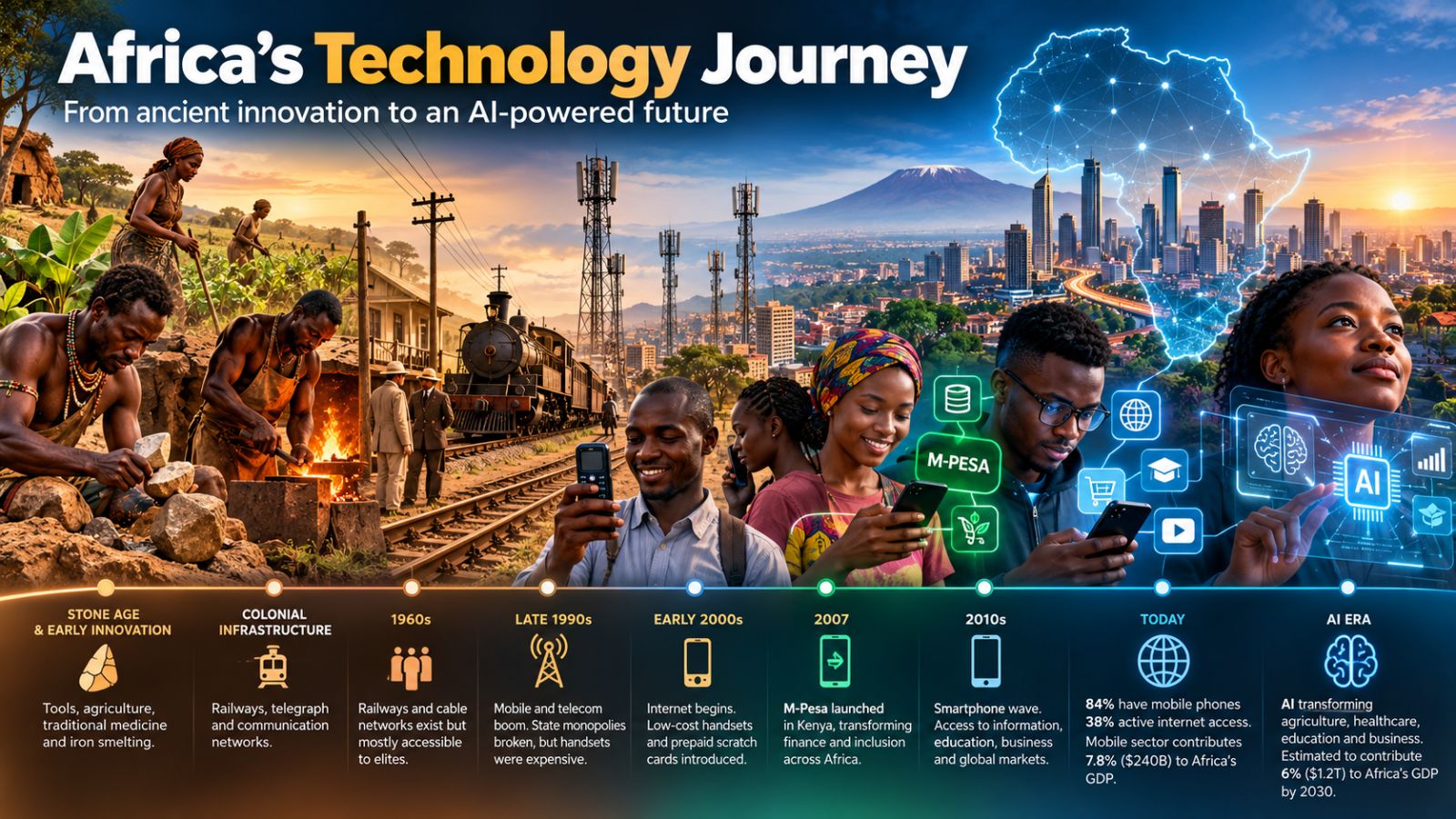
1. Africa Has Always Been Technological
When we talk about technology in Africa, the conversation often begins with smartphones, the internet or artificial intelligence. But Africa’s technological journey began long before these inventions existed.
During the Stone Age, early African communities developed tools that helped them hunt, cultivate land and adapt to their environments. Over centuries, communities developed complex agricultural systems, traditional medicine, metalworking and iron-smelting techniques. These were not merely survival mechanisms; they were technologies shaped by generations of observation, experimentation and knowledge.
Africa was never a continent without technology. It was a continent where technology evolved according to the needs, resources and knowledge of its people.
The colonial period introduced another layer of technological infrastructure. Railways, telegraph lines and other communication networks connected territories, cities and commercial centres. However, access to these systems was unequal. Much of the infrastructure served colonial administration, trade and extraction, while ordinary Africans had limited access to the services it enabled.
At independence in the 1960s, several African countries inherited railway networks and communication infrastructure. Yet owning infrastructure was not the same as making technology accessible. Access remained constrained by cost, geography, education and the concentration of services in urban centres.
This distinction would define much of Africa’s technological journey: the real breakthrough would not simply be inventing or importing technology, but making it accessible to ordinary people.
2. The Mobile Revolution: Connecting the Unconnected
The late 1990s marked a turning point. Telecommunications began expanding across the continent as mobile networks emerged and many countries liberalised their telecommunications sectors.
Companies such as Safaricom in Kenya, MTN in several African markets and Celtel expanded mobile services into populations that traditional telecommunications infrastructure had struggled to reach.
But there was a problem: affordability.
Early mobile phones were expensive luxury items, beyond the reach of most households. Network coverage was also limited, and the cost of calls could be prohibitive. The technology existed, but mass adoption remained a distant goal.
Operators gradually introduced prepaid services, more affordable handsets and flexible payment options. Instead of requiring customers to commit to expensive monthly subscriptions, prepaid scratch cards allowed people to purchase airtime according to their budgets.
This seemingly simple change helped reshape the market. People did not need to be wealthy to communicate. They needed a handset, network coverage and enough money to purchase airtime.
The results were remarkable. Mobile subscriptions expanded rapidly during the 2000s, transforming communication, commerce and social interaction across Africa.
Then came an innovation that would change the relationship between technology and money.
3. Kenya and the Mobile Money Breakthrough
In 2007, Safaricom launched M-Pesa in Kenya.
At the time, sending money over long distances could be difficult, expensive and unreliable, especially for people without access to formal banking services. M-Pesa used mobile phones to make it possible to transfer money, purchase services and conduct transactions without requiring a conventional bank account.
Its significance went far beyond convenience.
Small businesses could receive payments. Families could send money to relatives in rural areas. Workers could transfer earnings home. People previously excluded from formal financial systems gained new ways to participate in the economy.
Mobile money demonstrated something important: Africa did not always need to follow the same technological path as wealthier economies.
Rather than waiting for every community to develop a comprehensive network of physical bank branches, mobile technology enabled financial services to reach people through an existing and increasingly widespread device.
This was not simply the adoption of foreign technology. It was the development of a solution that responded to a distinctly local challenge and eventually attracted international attention.
M-Pesa showed that the most transformative technologies are often those that solve everyday problems at scale.
4. Smartphones: The Missing Link
By the late 2000s and into the 2010s, smartphones began changing what mobile technology could do.
A basic phone allowed people to communicate. A smartphone could connect them to information, education, entertainment, financial services, business tools and global markets.
It combined several technologies into one device: a camera, computer, navigation system, communication tool and gateway to the internet.
As lower-cost smartphones entered the market, more Africans gained access to digital services without needing to purchase a desktop computer or establish a fixed internet connection.
The consequences were significant.
A small business owner could advertise products on social media. A student could access educational materials online. A farmer could search for market prices. A freelancer could work with clients in another country. A young entrepreneur could build a digital business using little more than a phone and an internet connection.
The smartphone became more than a communication device. It became an entry point into the digital economy.
Yet the digital divide did not disappear. Many people still faced expensive data, unreliable electricity, poor network coverage and limited digital skills. Access to a smartphone did not automatically mean access to affordable, reliable internet.
Nevertheless, the direction was clear: technology was moving closer to ordinary people.
5. The AI Era: Another Turning Point
Today, Africa is entering another technological transition: the era of artificial intelligence.
AI is different from previous technological waves because it does not merely connect people or provide access to information. It can help people analyse information, generate ideas, automate repetitive tasks, solve problems and make decisions.
A smartphone placed the internet in someone's hands. AI can help that person do more with the information and tools available to them.
Consider a farmer who uses AI to identify a crop disease, a teacher who uses it to analyse student performance, or a small business owner who uses it to organise financial records. A fabricator can use AI to develop equipment designs, while a data steward can use it to clean spreadsheets, identify inconsistencies and integrate records into a master database.
These are not just possibilities for large technology companies. They are practical applications for people working in agriculture, education, healthcare, manufacturing and small businesses.
Kenya is particularly interesting in this transition. Its experience with mobile money, digital payments and technology-driven entrepreneurship provides a foundation on which AI applications can develop. Other countries, including South Africa, Rwanda, Nigeria, Egypt and Morocco, are also investing in digital capabilities and exploring AI applications.
Across the continent, AI is being explored for agricultural advisory services, medical support, language processing, education and business operations.
The opportunity is substantial. Some projections suggest that AI could contribute around $1.2 trillion to Africa's economy by 2030. Such estimates should be treated as projections rather than guaranteed outcomes, but they illustrate the scale of the opportunity being discussed.
The question is no longer whether AI will influence Africa. It is how deeply it will become integrated into everyday economic and social life.
6. Africa Must Build AI for African Problems
For AI to deliver meaningful value, it must address problems that African communities actually face.
Agriculture provides a clear example. Farmers need timely information about weather, pests, soil conditions, crop diseases and market prices. AI tools designed for local crops, farming conditions and languages could help make such information more accessible.
Healthcare presents another opportunity. AI-assisted systems could support health workers with information management, preliminary analysis and resource planning, provided they are appropriately validated and used with proper clinical oversight.
Language is equally important. Africa's linguistic diversity presents both a challenge and an opportunity. AI systems that understand African languages and local expressions could make digital services more accessible to people who are poorly served by tools designed primarily for English and other widely represented languages.
Small businesses could also benefit. Many operate with handwritten records, informal bookkeeping and limited access to professional services. AI could help them organise transactions, analyse sales, forecast demand and improve record keeping without requiring expensive software or specialist staff.
The most important measure of AI adoption should not be how many people have experimented with a chatbot. It should be whether people are using AI to improve productivity, increase incomes, expand access to services and solve persistent problems.
7. The Barriers Africa Must Overcome
Despite the opportunity, Africa faces significant obstacles.
Infrastructure remains fundamental. AI depends on electricity, connectivity, computing capacity and reliable digital systems. Where power is unreliable or internet access is expensive, even the most advanced AI application can remain impractical.
Affordability determines adoption. A tool may be technically available but still inaccessible to someone who cannot afford the data, device or subscription required to use it regularly.
Skills and talent matter. Africa needs people who can build, maintain, evaluate and govern AI systems, not only people who can use existing applications. When skilled professionals leave for better opportunities elsewhere, local institutions and businesses can struggle to retain the expertise required to develop homegrown solutions.
Data quality is another challenge. AI systems depend on data, yet many organisations struggle with incomplete records, inconsistent formats, limited digitisation and fragmented information systems. Poor-quality data can undermine otherwise promising AI projects.
Governance and data protection cannot be ignored. Organisations need clear rules on privacy, consent, accountability, security and the responsible use of AI. Poor governance can expose people to discrimination, misinformation, surveillance or misuse of personal information.
Finally, Africa must address the question of technological dependence. If the continent only consumes AI products developed elsewhere, it risks remaining dependent on external platforms, infrastructure, intellectual property and business priorities.
Adopting technology is important, but developing the capacity to shape it is equally important.
8. The Next Five Years: What Direction Will Africa Take?
Looking towards 2030, several possible developments deserve attention.
First, AI may become embedded in everyday tools rather than remaining a separate technology. Farmers, teachers, accountants, healthcare workers, mechanics and business owners may increasingly use AI through applications they already understand.
Second, local-language AI could widen access to digital services. If systems become more capable of understanding African languages and local contexts, more people could benefit without needing advanced technical skills or fluency in a dominant international language.
Third, African businesses may begin automating more of their routine operations. This could improve productivity, but it will also require workers to develop new skills and organisations to rethink how work is performed.
Fourth, demand for local computing infrastructure, data centres, energy and AI training could encourage new investment. Partnerships between African technology companies and global technology providers may help expand capacity, although the long-term benefits will depend on ownership, affordability, skills development and the value retained within African economies.
Finally, AI could influence how governments and institutions deliver services, allocate resources and analyse public information. The benefits will depend on data quality, transparency, safeguards and public trust.
None of these outcomes is guaranteed. Infrastructure investment may lag behind demand. AI tools may remain unaffordable for many communities. Skills shortages and weak governance could limit progress. The technology could also increase inequality if its benefits concentrate among those who already have resources and opportunities.
The next five years will therefore be shaped not only by technological advances, but by the decisions African countries make about access, investment, education, governance and local innovation.
9. From Technology Consumers to Technology Creators
Africa's history offers an important lesson: technology becomes transformative when people adapt it to their needs.
Traditional agricultural systems responded to local environments. Mobile money addressed barriers to financial inclusion. Smartphones expanded access to information and digital services.
AI now offers another opportunity to build on that history.
But the ambition should go beyond giving more people access to tools developed elsewhere. Africa needs to develop local talent, support research, improve data infrastructure, invest in reliable electricity and connectivity, and create an environment where entrepreneurs can build solutions for African markets.
It also needs to ask difficult questions. Who owns the data? Who controls the infrastructure? Who benefits economically? Are local languages and knowledge represented? Will AI expand opportunity, or will it reinforce existing inequalities?
The answers will help determine whether AI becomes another imported service or a foundation for locally driven technological development.
Conclusion: Only Time Will Tell
Africa's technological journey stretches from stone tools and iron smelting to railways, mobile networks, mobile money, smartphones and now artificial intelligence.
Each period has brought new opportunities, but also new barriers. The mobile revolution demonstrated that affordability and relevance can accelerate adoption on a massive scale. AI will require the same attention to accessibility, but it will also demand stronger infrastructure, better data, deeper technical skills and responsible governance.
By 2030, Africa could be using AI to transform agriculture, education, healthcare, manufacturing and small businesses. It could also find itself constrained by the same challenges that have limited earlier waves of technological progress.
The future will depend on what African governments, businesses, institutions and communities do today.
The question is not whether Africa will embrace AI. The question is whether Africa will simply use it, or help build, shape and own the technologies that define its future.
Only time will tell.
Login to Comment