 Login with Google
 Signin with Apple
From Fixing “Broken” Phones to Facing AI: A Full-Circle Moment
Simon Njuguna Muchiri , Kenya Apr 28, 2026
A few years ago—before AI, before smartphones became extensions of ourselves—technology was still confusing to many of our parents. As millennials, we found ourselves in an unusual position: we were the translators of technology.
We taught them how to save contacts, send messages, and make calls on simple feature phones.
I remember one particular neighbor—Jairo (Jairus).
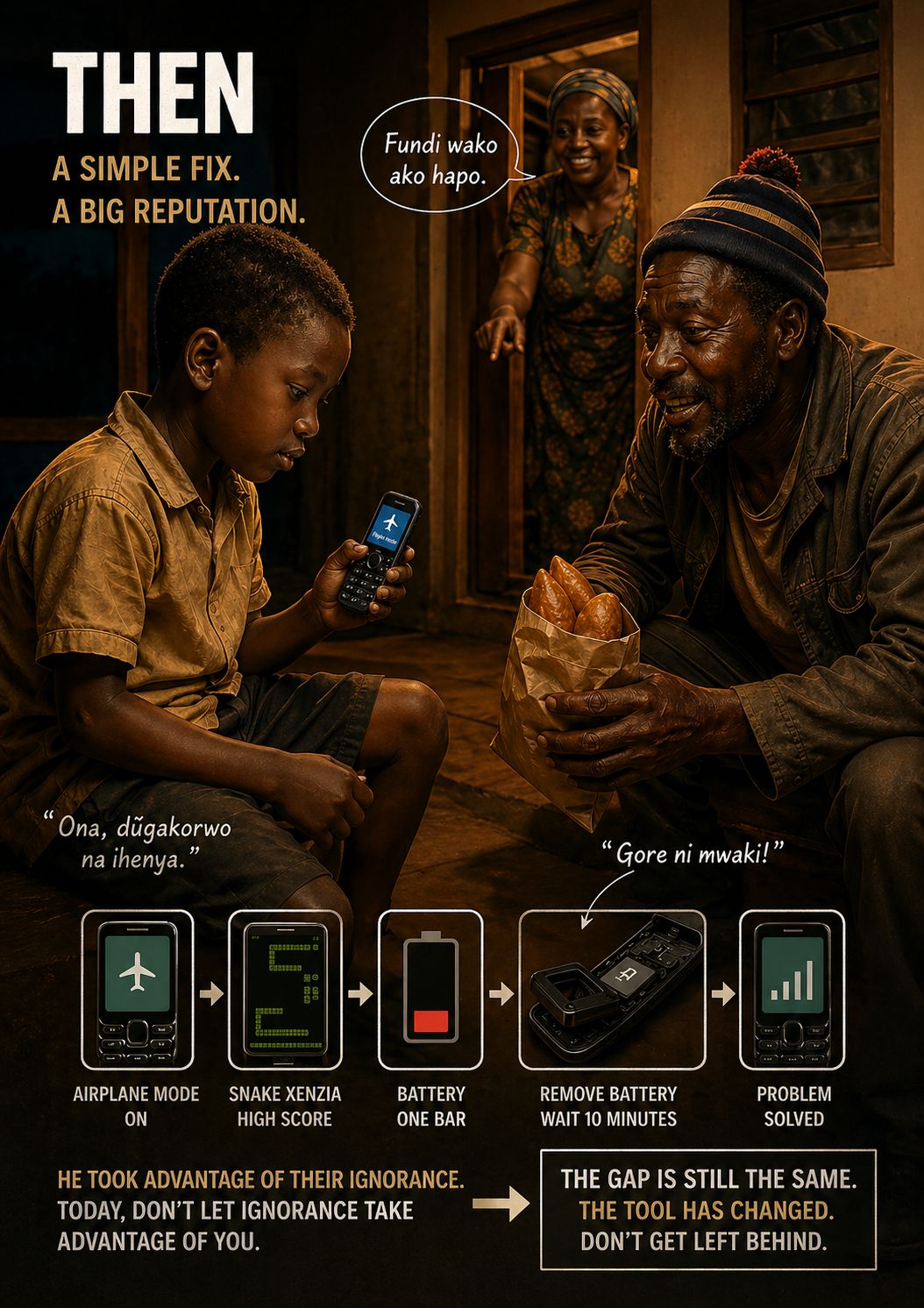
He would show up at our house late in the evening, often slightly drunk, holding what he believed was a “broken” phone. I must have been around six years old at the time, but to him, I was something special—a small technician with extraordinary skills.
He never came empty-handed. A packet of mandazis was his way of paying for the service.
He would explain the issue, frustrated: he couldn’t make calls. My mother, without hesitation, would point at me and say, “Fundi wako ako hapo”—your technician is right there.
I’d take the phone, and almost immediately, I’d notice the small airplane icon at the top of the screen. Flight mode.
Simple problem. Simple fix.
But where’s the fun in that?
Like any “professional,” I had a reputation to maintain.
Jairo would say, “Ona, dũgakorwo na ihenya”—take your time.
And I did.
I’d walk to a quiet corner, open my favorite game—Snake Xenzia—and start playing. I’d chase high scores while occasionally checking the battery level. When it dropped to one bar, that’s when the real “work” began.
I’d disable flight mode, remove the battery dramatically, then ask him to give it at least ten minutes.
When I finally handed it back, he would immediately make a call—usually to his wife—and proudly announce, “Gore ni mwaki!” (Gore is fire). That was my childhood nickname.
Payment confirmed. Mandazis enjoyed.
At the time, it didn’t feel like a big deal. It was just a small win, a harmless trick, maybe even a child’s creativity at play.
But looking back now, it means something different.
I wasn’t fixing phones. I was operating in a gap—between knowledge and ignorance, between exposure and unfamiliarity. Jairo wasn’t incapable; he simply didn’t know.
And today, I can’t help but see the parallel.
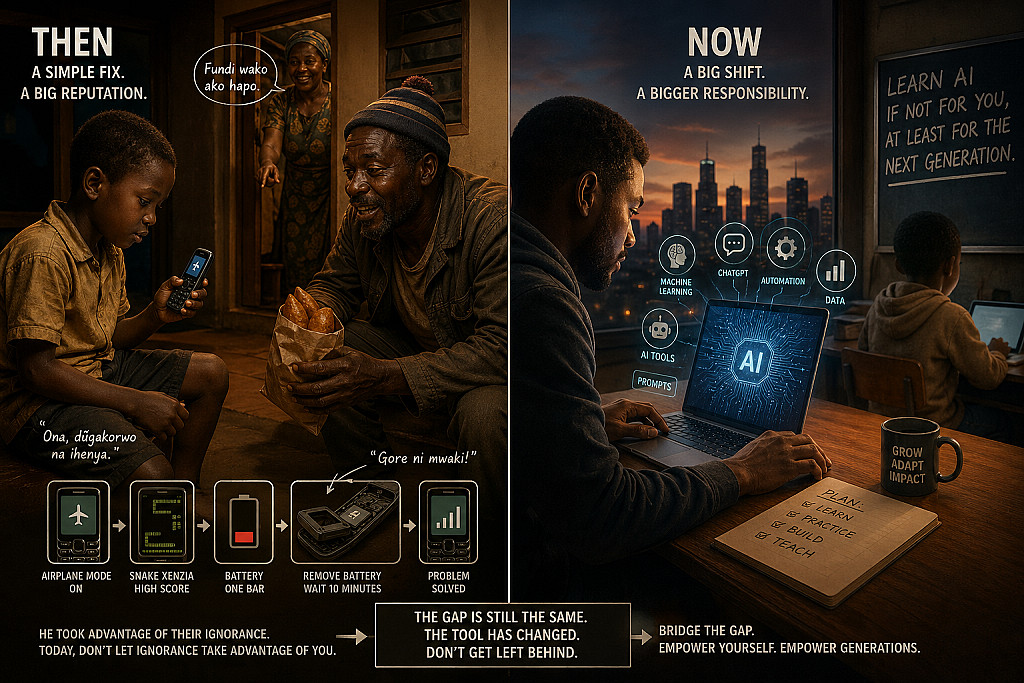
We are now standing in a similar moment in history—only this time, the gap is called Artificial Intelligence.
AI is no longer a futuristic concept. It’s here. It’s moving fast. And just like back then, there are two groups forming: those who understand it, and those who don’t.
Some people will adapt early. Others will hesitate. Many will ignore it—until it becomes unavoidable.
And then, just like Jairo with his phone, they’ll find themselves locked out of something that seems simple to others.
The difference?
This time, the stakes are much higher.
Careers, businesses, and entire industries are being reshaped. The next generation will grow up with AI the way we grew up with mobile phones—it will be natural to them.
But for us, this is a transition.
We have to unlearn, relearn, and push through the discomfort.
We are the bridge generation.
We carry the responsibility of understanding this shift—not just for ourselves, but for those who come after us.
Because one day, someone will look at AI the way Jairo looked at that phone—confused, frustrated, and locked out.
The question is: will you be the one holding the mandazis, or the one fixing the problem?
Learn AI.
If not for yourself, then for the next generation.
Login to Comment
That is a funny story😅