 Login with Google
 Signin with Apple
Simon's Records
Simon's Badges
Simon's Blogs
Aug 24, 2026
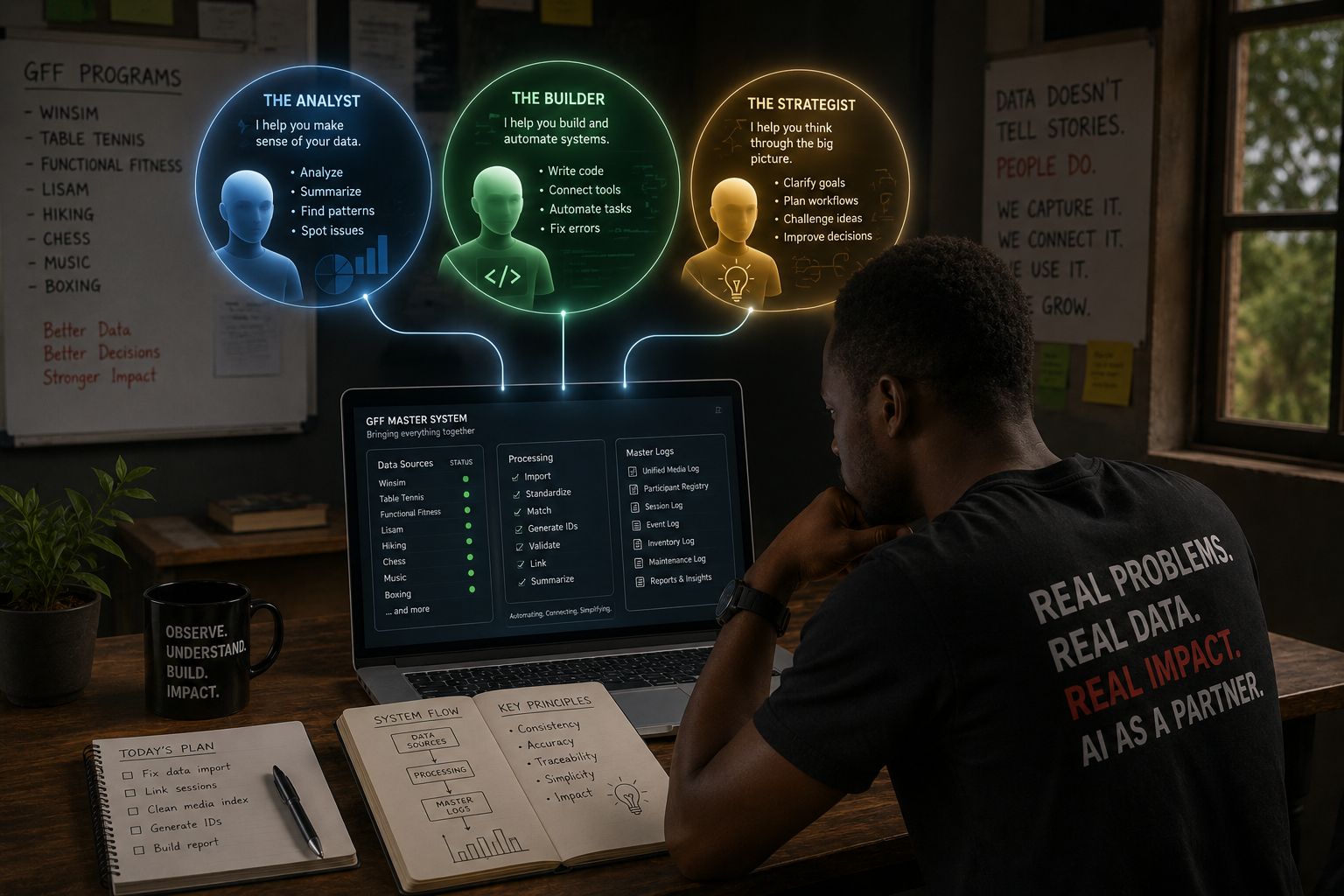
AI Is Good at Code. But It Still Doesn't Understand Your Organization
One of the biggest things I've learned from using AI at Global Fast Fit is that artificial intelligence can be extremely good at solving technical problems. But there's something it still doesn't automatically understand: the organization itself.
It can write code. It can suggest formulas. It can analyze data. It can explain Python. It can even help design a system. But it doesn't automatically know what that system means to the people using it.
The Difference Between a Technical Problem and a Real Problem
Suppose I tell AI: "I have several spreadsheets and I want to combine them into one master sheet." That sounds like a technical problem. AI can immediately suggest formulas, scripts, database structures, and different ways of importing information. But there are questions behind that request AI can't answer on its own.
Which spreadsheet is the authoritative source? Why are there several spreadsheets in the first place? Who enters the information? Why are the records structured differently? What happens when information is missing? Which fields actually matter? What should happen to an incorrect record? Who needs to use the final data?
Those aren't coding questions. They're organizational questions, and they require someone who understands what's actually happening on the ground.
AI Sees the Data. I See the Story Behind It.
When I work with GFF data, I know that a row is never just a row. There's usually a reason it exists. A participant record represents a person. A session represents an activity that actually happened. A video represents something that was recorded. An event represents people coming together. A piece of equipment represents something someone needs to use. A missing record may represent something that happened but was never properly documented.
AI can process the information I give it. But it doesn't automatically know the story behind that information — and that distinction became very important as I started building and connecting systems at GFF.
You Have to Teach AI Your Organization
The more complex the work became, the more context I had to provide. I had to explain what different programs were doing, what different columns meant, how sessions related to videos, how participants related to events, why certain IDs mattered, and what I considered a correct record. Only after providing that context could AI start giving me solutions that actually fit the organization.
That taught me something: AI doesn't arrive knowing your organization — you have to teach it. And the better you understand your own organization, the better you can use AI.
This Is Where Human Knowledge Becomes Valuable
There's sometimes a fear that AI will make human knowledge less important. My experience has actually made me think the opposite. The more capable AI becomes, the more valuable the person who understands the actual problem becomes.
If I know exactly what GFF needs, I can use AI very effectively. If I don't understand the organization, AI can produce a technically impressive solution that solves the wrong problem — and that can be worse than having no solution at all. A beautifully written script that does the wrong thing is still wrong.
I Learned This Through Trial and Error
My work with Apps Script taught me this repeatedly. I could ask ChatGPT to create a script, and it would look completely reasonable. Then I'd run it against the actual data and something wouldn't match — a row imported incorrectly, an ID generated in the wrong place, a record that didn't connect to the session I expected, an assumption that didn't match how our system actually worked.
At that point, I'd have to go back and explain the organization more clearly. The problem usually wasn't that the AI couldn't write the code. The problem was that I hadn't fully communicated the system. That was an important lesson.
Chess Gave Me Another Example
Chess provided another unexpected example. When we recently wanted to analyze tournament games stored in a PGN file, the technical task was relatively straightforward: read the PGN, extract the games, analyze the moves, produce useful information.
But even there, the interesting questions weren't purely technical. What do we actually want to learn from the games? Individual player performance? Blunders? Opening choices? Patterns across the tournament? How players made decisions? Those questions determine what the analysis should actually do. Python can process the PGN, and AI can help write the Python — but we have to decide what's worth analyzing.
AI Can Build the Tool. You Define the Purpose.
This has become one of my simplest ways of thinking about AI. It can help build the tool; humans have to define the purpose. It can help write the database query; humans have to decide what information matters. It can help write the Apps Script; humans have to decide what the workflow should be. It can help analyze the chess games; humans have to decide what they want to learn from them. That relationship works very well when both sides are doing what they're good at.
Context Is Everything
I've also learned that the quality of the answer I get from AI depends heavily on the quality of the context I provide. A vague description gets a generic solution. But when I explain the actual workflow, the data structure, the constraints, the mistakes I've already encountered, and what the final system needs to achieve, the quality of the response changes significantly.
That's forced me to become better at documenting my own thinking. I have to know what I'm asking. I have to understand what I'm trying to achieve. I have to separate the actual requirement from the solution I initially imagined — and sometimes admit my original approach was wrong.
AI Doesn't Walk Into the Building
There's another difference that's easy to overlook. AI doesn't experience the organization. It doesn't walk into GFF and see the people using the equipment. It doesn't watch a chess tournament unfold. It doesn't see someone struggling to record information, or notice that a process which looks perfect on paper is inconvenient for the person actually using it. It doesn't hear the conversations around a problem, or observe the unexpected things that happen during normal operations.
People do. And that real-world experience matters.
The Best Systems Come From Both
I've come to believe that the best results happen when human experience and AI capability are combined.
The human brings context, experience, judgment, purpose, organizational knowledge, an understanding of people, and awareness of what's practical. AI brings speed, technical knowledge, pattern recognition, coding assistance, ideas, alternative approaches, and the ability to work through large amounts of information.
Neither side is enough on its own. But put them together, and something interesting happens — a person who understands the problem can suddenly build things they might previously have considered beyond their ability.
The Lesson I Took From GFF
My experience at Global Fast Fit has taught me that technology should serve the organization, not the other way around. It's easy to get excited about building a sophisticated system. It's much harder to ask whether that system actually solves the right problem.
That's why I now try to start with the organization rather than the technology: first understand what's happening, then understand what's going wrong, then define what needs to change. Only after that should you decide whether the answer is a spreadsheet, a formula, Apps Script, Python, AI, or something completely different.
AI Can Be Powerful Without Being in Charge
I don't think the future of AI is necessarily about AI taking over every decision. From my experience, I see something more practical: AI becomes incredibly powerful when it works alongside people who understand the problems they're trying to solve.
At GFF, AI has helped me move into areas I wouldn't have expected to explore. But the organization still gives the work its meaning. The people still define the problems. The human still checks the result, and the human still decides whether the solution makes sense.
That's perhaps the most important lesson I've learned: AI can help you build the solution, but you still need to understand the problem. Because no matter how good the code is, a technically perfect solution to the wrong organizational problem is still the wrong solution.
Jul 21, 2026
Why Data Ingestion Matters: My Journey to Becoming DataUniversa Certified
There is a common saying in data science:
"A model is only as good as the data it learns from."
As artificial intelligence becomes increasingly integrated into our daily lives, one question becomes more important than ever:
Where does high-quality data come from?
Recently, I completed the DataUniversa Data Ingestion Training System and was honored to receive certification after achieving a 10/10 score in the Functional Fitness dataset assessment.
While receiving the certificate was rewarding, the real value was understanding the discipline required to transform human experience into structured knowledge that AI systems can actually learn from.
Data Is More Than Information
Many people think data collection simply means filling in forms or recording numbers.
In reality, meaningful data ingestion is about preserving context.
It means capturing not only what happened, but also:
the original problem,
the starting conditions,
observations,
reasoning,
interventions,
failures,
outcomes,
supporting evidence,
and the lessons that others can apply.
Without that context, data becomes isolated facts. With context, it becomes knowledge.
Applying These Principles in Practice
The timing of this certification could not have been better.
Over the past several months, I have been redesigning the Global Fast Fit (GFF) organizational data system, transforming multiple independent Google Sheets into a centralized, governed information system.
That work involved:
designing permanent unique identifiers,
improving data integrity,
implementing centralized governance,
creating provenance tracking,
automating synchronization using Google Apps Script,
and documenting the complete engineering journey as a HOSI (Human-Originated Solution Intelligence) case study.
The DataUniversa training reinforced something I had already begun to appreciate: Good AI starts with good human documentation.
If the reasoning behind a solution is never recorded, AI can only learn the outcome—not the process that produced it.
The Importance of Human-Originated Solution Intelligence
One of the most exciting ideas introduced through DataUniversa is that people should not only contribute data—they should contribute solutions.
Every solved problem represents valuable knowledge.
Whether the challenge involves healthcare, education, engineering, business, agriculture, or organizational systems, documenting how a solution was discovered allows both humans and AI systems to learn from real-world experience.
This philosophy aligns closely with the HOSI framework, where complete solution journeys are preserved rather than simply recording successful outcomes.
Receiving this certification is not an endpoint.
It marks the beginning of a deeper commitment to building systems that are:
reliable,
auditable,
evidence-based,
reproducible,
and designed for long-term learning.
As organizations increasingly adopt AI, the quality of their future systems will depend heavily on the quality of the knowledge we preserve today.
I'm grateful to the DataUniversa team for developing a training program that emphasizes structured thinking, evidence, and responsible data ingestion.
I look forward to applying these principles in future projects and contributing additional HOSI case studies that help build better knowledge for both people and intelligent systems.
Certificate Achievement
Certification: DataUniversa Data Ingestion Training System
Dataset: Functional Fitness
Score: 10/10
Certificate Awarded: July 18, 2026
This achievement reminds me that the future of AI isn't built solely by better algorithms—it's built by better knowledge, carefully documented by people who solve real problems.