 Login with Google
 Signin with Apple
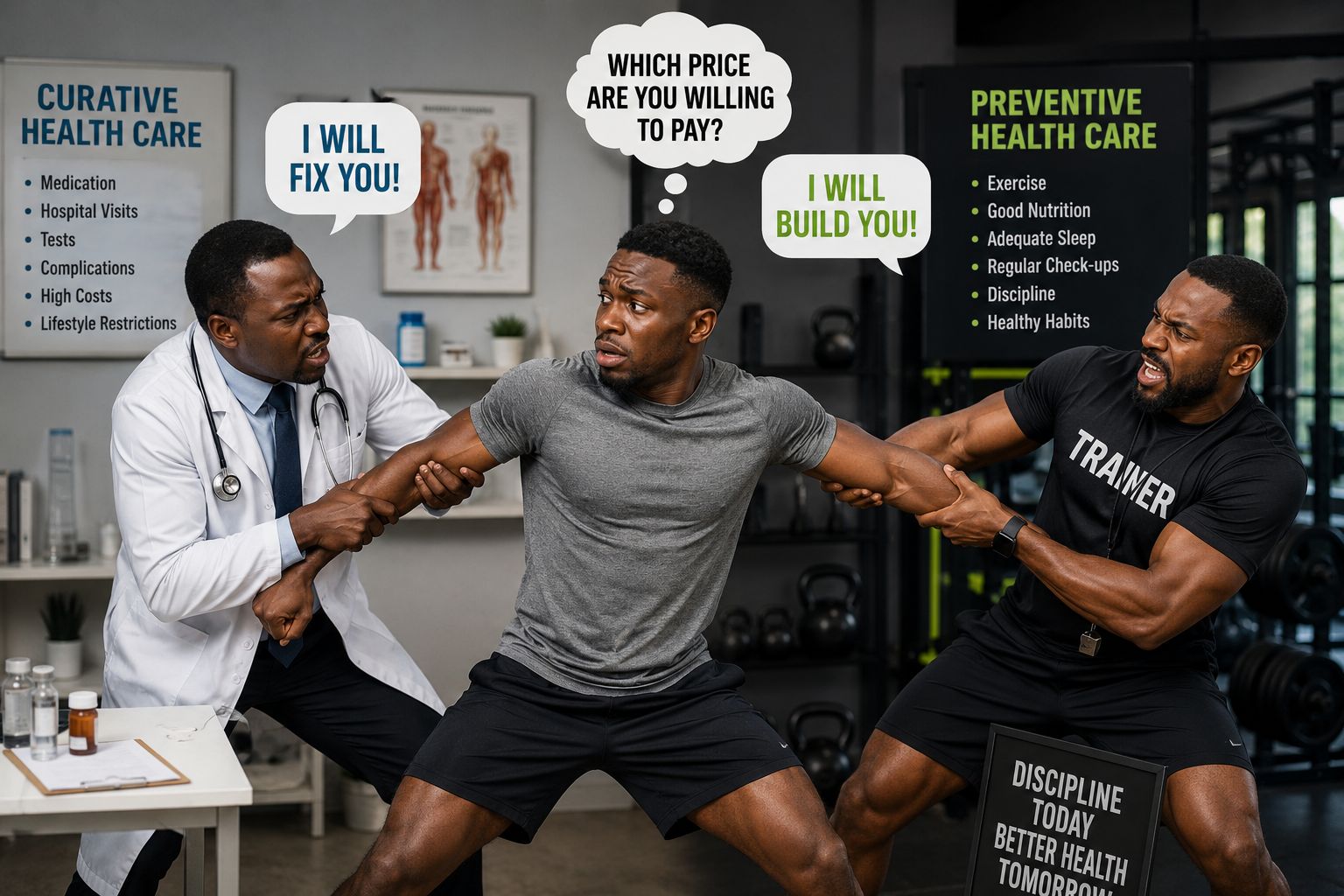
Preventive or Curative Health Care: Which Price Are You Willing to Pay?
Kelvin Njihia Kairu , Kenya Aug 22, 2026
Disclaimer: I am not a doctor, and I stand to be corrected by medical professionals. This is simply an observation based on my experiences, conversations with health professionals, and the things I have been learning about health and lifestyle.
In the Global Fast Fit fraternity, most of you know Dr. James. But today—just today—you can call me Dr Kelvin.
I have listened to Dr. James speak about lifestyle diseases, read articles, listened to health professionals, and observed people around me. One thing has become increasingly clear to me:
There is a thin line between preventive health care and curative health care—but both come at a cost.
And perhaps the bigger question is:
Which cost are you willing to pay?
Prevention has a price.
Preventive health care sounds simple when we talk about it.
Wake up early.
Exercise.
Go to the gym—or engage in whatever form of physical activity you enjoy.
Watch what you eat.
Reduce excessive sugar and unhealthy foods.
Avoid smoking and excessive alcohol.
Get enough sleep.
Go for medical check-ups.
Maintain a healthy weight.
Sounds easy, right?Not necessarily.
Prevention requires discipline. It requires saying no when everyone else is saying yes. It may mean waking up when your bed is still warm and going for a walk. It may mean choosing water instead of another sugary drink. It may mean reducing foods you love.There are sacrifices involved. And sometimes you may even ask yourself, “Why am I doing all this when I feel perfectly healthy?”
That's the tricky part about prevention. You are making sacrifices today for a problem you may never experience tomorrow.
But curative health care also has a price
Now consider the other side.
Someone develops a lifestyle-related condition and needs treatment. Suddenly, there may be medication to take every day. There may be foods to reduce or completely avoid—not because you chose to, but because your doctor has advised you to. There may be regular hospital visits, tests and monitoring. There may be complications. There may be financial costs. And perhaps most importantly, there may be things you once did freely that you can no longer do in the same way. The irony is that some of the sacrifices we resist making for prevention can eventually become sacrifices we are forced to make because of illness. The difference is that prevention gives you more room to choose.
The choice is not always ours
Of course, we should be careful not to oversimplify this. Not every disease can be prevented by going to the gym or eating well.
Genetics matter.
Age matters.
Environment matters.
Accidents happen.
Some illnesses occur despite people doing everything “right.” And sometimes people simply do not have the resources, information or circumstances necessary to make healthy choices. So this isn't about blaming sick people for their illnesses. It is about recognizing the things that are within our control.
We already know many of the choices
This is perhaps the most interesting part. Most of us already know what we are supposed to do. We know smoking is harmful. We know excessive alcohol consumption can be harmful. We know physical inactivity isn't good for us. We know that constantly eating poorly isn't ideal. We know that sleep matters. We know that carrying excessive weight can increase the risk of certain health problems. We know we should get checked when something doesn't feel right.
The problem is rarely a complete lack of information. The problem is often action.
We want the benefits of good health without paying the price that comes with maintaining it. But health doesn't work that way.
Every choice has a price
This is where my “Dr Kelvin” theory comes in. 😂
Maybe the question isn't: “How do I avoid paying a price?” Maybe the question should be:
“Which price am I willing to pay?”
Preventive health may cost you early mornings, discipline, exercise, dietary changes and saying no to certain habits.
Curative health may involve medication, hospital visits, dietary restrictions, monitoring, treatment costs and sometimes complications. Neither path is completely free. Both require sacrifices.
The difference is that with prevention, you are often paying a smaller price today in the hope of avoiding a much bigger price tomorrow. And that, to me, is the real value of preventive health.
Don't wait for your body to negotiate on your behalf
One of the biggest mistakes we make is waiting until the body forces us to pay attention. We ignore the small signs.
We postpone check-ups. We say, “I'll start exercising next month.”
We say, “I'll change my diet when I start feeling sick.”
We say, “I'm still young.”
But health doesn't always give us a warning before the bill arrives.
Sometimes prevention is simply choosing to take responsibility for the things we can control while we still have the opportunity to do so.
Exercise.
Eat reasonably well.
Sleep.
Avoid harmful substances.
Get appropriate medical check-ups.
Listen to your body.
And when something is wrong, seek professional medical advice rather than trying to diagnose yourself from Google—or from Dr Kelvin.
So, which poison suits you best?
Maybe that sounds like a strange question. But in reality, both choices come with inconveniences.
One asks you to sacrifice some comfort now for the possibility of a healthier future.
The other may require you to sacrifice some comfort later because your health has already demanded attention. You cannot always choose whether illness will come. But you can influence how you treat your body while you have the chance. Preventive health isn't a guarantee that you will never get sick.
Curative health isn't a failure.
And choosing treatment when you are sick is not something to be ashamed of. But if there are things we can reasonably do today to reduce our risk tomorrow, perhaps they are worth doing.
Because at the end of the day, both prevention and treatment have a cost.
The question is:
Which price are you willing to pay? — Dr Kelvin 😂
Disclaimer: This is a personal reflection and is not medical advice. I am not a doctor. For medical concerns, diagnosis, treatment and individual health decisions, consult a qualified healthcare professional.
Login to Comment