 Login with Google
 Signin with Apple
Every Organisation Is Fighting a War- Structure Win the Mission
Kelvin Njihia Kairu , Kenya Aug 22, 2026
Today, I am not blogging about fitness. Today, I am blogging about structure.
If you have followed most of my blogs, you probably already know what to expect from me. Fitness, exercise, nutrition, trainers, clients, lifestyle diseases and everything in between. But today, let's leave the gym for a moment.
Let's talk about organisations.
One of the most interesting examples of planning and execution in modern history is the operation that led to the death of Osama bin Laden.
This is not an article about celebrating terrorism or revisiting the pain caused by 9/11. I am looking at the operation from a completely different perspective: planning, intelligence, reconnaissance, communication, clear instructions, resources and execution.
Think about it.
The operation did not simply begin with someone saying, "Let's go and get him."
There was intelligence gathering. There was surveillance and reconnaissance. There was analysis. There were people whose job was to understand the target and the environment. There was a chain of command. There were specialised teams. There were resources and equipment. There were instructions.
Then came the day of execution. The Navy SEALs were not walking into an unknown environment without preparation. They were executing a mission that had been planned, studied and rehearsed.
If that planning had not been done, the mission could have ended very differently — potentially as a catastrophe.
And this is where the lesson becomes relevant to every organisation.
Organisations Go to War Every Day
Not the physical kind of war. Businesses, organisations, gyms, schools, hospitals, NGOs and government institutions are fighting their own battles every single day.
They are fighting for customers.
They are fighting for efficiency.
They are fighting against competition.
They are fighting to meet targets.
They are fighting to retain employees.
They are fighting to deliver better services.
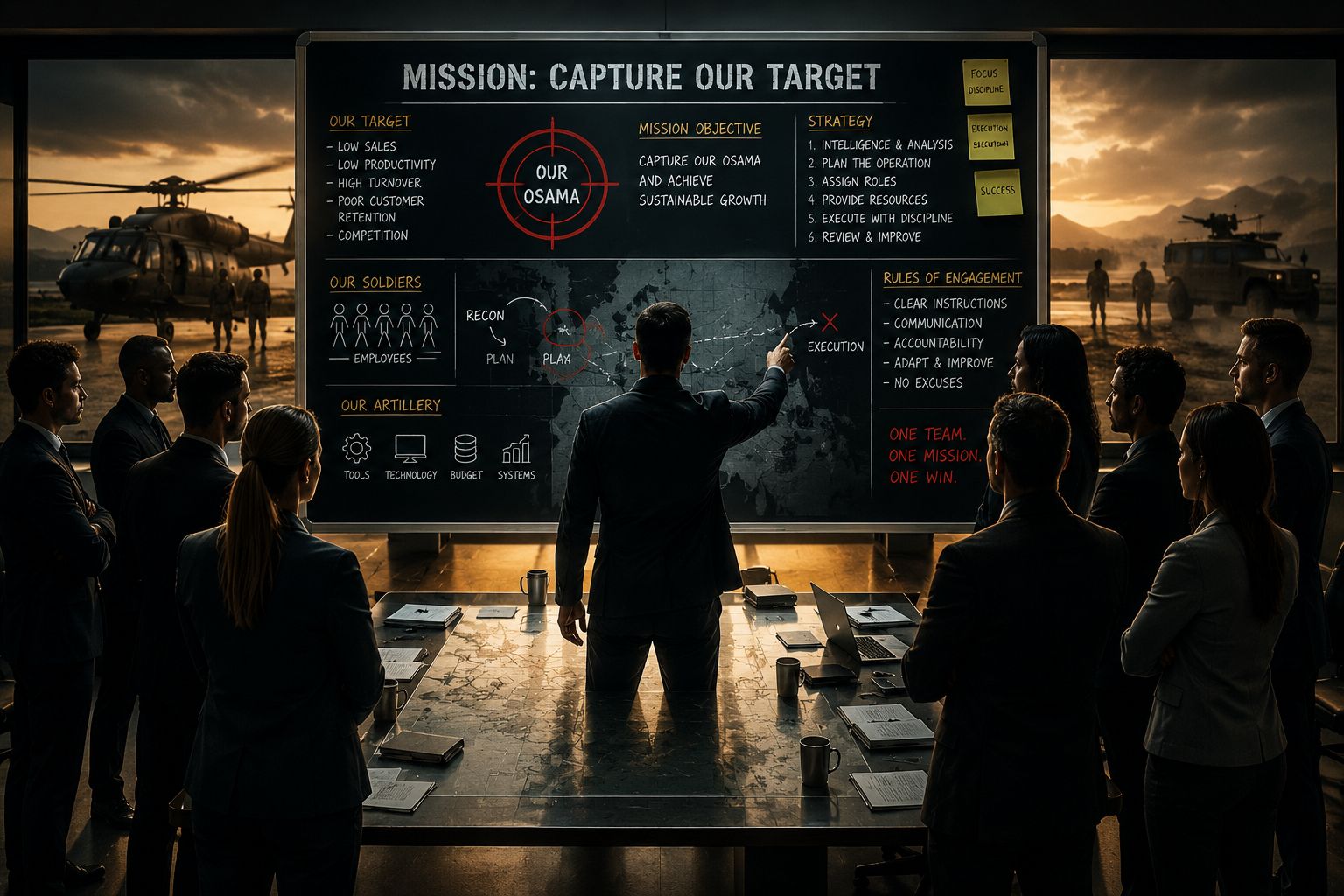
In a way, organisations are trying to capture their own Osama every month, every quarter, every year. The target could be poor sales, low productivity, high staff turnover, poor customer retention, financial problems, competition or simply a target that the organisation has failed to achieve for years.
And if the structure is poor, Osama keeps escaping.
You keep setting the same target.
You keep identifying the same problem.
You keep holding the same meetings.
You keep discussing the same weaknesses.
Yet months later, you are still chasing the same thing. Why?
Because wanting to capture the target is not enough.
You need a mission.
Every Organisation Has Soldiers and Artillery.
Every Organisation has soldiers. The employees are the soldiers.
Every organisation has artillery .The tools, equipment, technology, systems and resources available to employees are the artillery.
And most importantly, every organisation needs a general. Not necessarily one person sitting in an office giving orders, but a leadership structure that understands the mission, develops the strategy and communicates it clearly through the chain of command. Take away any one of these and the mission becomes vulnerable.
You can have the best soldiers in the world, but if they have no equipment, they are limited. You can have the best equipment, but without people who know how to use it, it becomes useless.
You can have excellent employees and excellent resources, but without a plan, everyone can be moving in different directions.
Soldiers + artillery + strategy.
That combination gives an organisation a fighting chance.
Planning Should Come Before the Battle.
One of the biggest mistakes organisations make is expecting employees to figure everything out as they go.
A new month begins.
Everyone reports to work.
Targets are announced halfway through the month.
Instructions change.
Priorities change.
People are moved from one responsibility to another. Then, when the results are poor, someone asks:
"Why didn't we achieve our target?"
But perhaps the better question is:
"Did everyone know the mission?"
Every organisation should have a clear structure before entering its next "battle."
It could be a monthly plan.
A quarterly plan.
A yearly plan.
Whatever the period, the principle remains the same:
People need to know where they are going before you ask them to run.
At the beginning of every month, every employee should understand:
- What are we trying to achieve?
- What is my role?
- What are my targets?
- What worked last month?
- What did not work?
- What are we maintaining?
- What are we changing?
- What resources do I have?
- Who do I report to?
- Who do I work with?
- How will success be measured?
This may sound simple.
Because it is.
And perhaps that is the frustrating part.
Some of the things that make organisations fail are not complicated problems. They are simple things that were never properly structured.
Give Every Soldier a Mission
Imagine sending ten soldiers into a battlefield and telling them:
"Go and do your best."
But nobody tells them the objective.
One goes left, Another goes right, Another waits, Another starts fighting a completely different battle, Another does not even know why they are there.
Would we blame the soldiers?
Maybe.
But the bigger problem would be the command structure. The same thing happens in organisations.
An employee cannot be expected to perform at their best when their responsibilities are unclear.
Give every employee a mission. Not just a job title. A job title tells you what position someone occupies.
A mission tells them what they are expected to accomplish.
And once the mission is clear, allow the employee to perfect their role.
But Don't Kill Individual Brilliance.
Structure does not mean turning employees into robots.
In fact, one of the biggest mistakes leaders can make is creating such a rigid system that people are afraid to think.
Every organisation has individuals who can see things differently. Someone may notice a problem nobody else has noticed. Someone may have a better way of serving customers. Someone may discover a more efficient process.
Someone may have an idea that changes the entire organisation.
Individual brilliance is an asset. Leadership should not suppress it.
Leadership should give it direction. A good structure should tell people where the organisation is going, while still giving them enough room to figure out how to get there better.
The Danger of Changing The Mission Mid-Battle.
Here is where many organisations lose the battle. They start the month with Plan A. Halfway through the month, leadership introduces Plan B.
Then Plan C appears.
An employee who was given one responsibility suddenly receives another.
A system that was working is abandoned.
Targets change without explanation.
Priorities shift without a replacement strategy. And sometimes, there is not even a backup plan. Change is necessary. Organisations must adapt.
But changing direction without communicating the new mission creates confusion.
If Plan A is no longer working, explain why. Develop Plan B.
Give people new instructions.Provide the resources required.
Explain what has changed.Then let everyone execute.
Don't change the mission and expect the soldiers to somehow know the new battlefield.
Q&A is Part Of Perfecting the Mission.
Questions are not a sign of weakness. They are part of preparation.
If an employee asks:
"What exactly do you want me to achieve?"
That question should not irritate a leader.
It should make the leader happy.
Because it gives the organisation an opportunity to remove confusion before confusion becomes failure.
Regular Q&As, reviews and check-ins are therefore not simply meetings. They are opportunities to refine the mission.
What worked?
What failed?
Why did it fail?
What did we learn?
What should we maintain?
What should we stop?
What should we change?
That is how an organisation becomes better. The Mission Is Bigger Than One Person
There is another important lesson here.
The success of an organisation should not depend entirely on one individual.
A great employee without support will eventually become frustrated.
A great manager without a capable team will eventually become overwhelmed.
Great equipment without skilled people will sit unused.
And great strategy without execution remains just a document.
Everything is interconnected.
The soldier needs the artillery. The artillery needs the soldier.
Both need a plan.
And the plan needs leadership, communication and execution.
Remove one piece and the entire system becomes weaker. Every Month Is Another Mission
Perhaps this is how organisations should approach their work.
At the beginning of the month:
Here is our mission.
Here is what we achieved last month.
Here is what did not work.
Here is what we are maintaining.
Here is what we are changing.
Here is your role.
Here are your targets.
Here are your resources.
Here is who you report to.
Then let everyone execute. At the end of the month:
Did we win?
If yes, why?
If no, why?
Then learn and prepare for the next mission. Because the objective is not to have a perfect month every month.
The objective is to build an organisation that learns from every mission.
The Final Lesson
The operation that led to Osama bin Laden was successful because it was more than simply sending people to a location.
It involved intelligence, planning, preparation, resources, leadership, communication, specialised personnel and execution.
Had those elements not come together, the consequences could have been catastrophic.
Organisations should understand the same principle.
Do not send people into battle without telling them what they are fighting for.
Give them the tools.
Give them the information.
Give them the structure.
Give them clear instructions.
Give them room to use their individual brilliance.
And when the plan changes, communicate the change.
Because at the end of the day:
A mission without soldiers cannot be executed.
Soldiers without artillery are limited.
Artillery without soldiers is useless.
And soldiers and artillery without a plan can still lose the war.
Today, I am not talking about fitness. I am talking about structure.
And perhaps the greatest competitive advantage an organisation can have is not having the most talented people or the most expensive equipment.
It is having the right people, the right tools, the right structure and a clear mission — all moving in the same direction.
Login to Comment