 Login with Google
 Signin with Apple

Queen of Rope
Dr. James Muchiri , Kenya May 31, 2026 2
How twelve women over thirty in Nyandarua are climbing a dynasty of African queens — one skip at a time.
It started with a walk
Early this year, in our capacity as Nyandarua County's official fitness partner, we were asked to help condition Rufas — the county's immunization champion — for a 62-kilometre walk to get people talking about immunization. He made the distance. And afterwards, in the speeches, someone handed us a challenge that wasn't quite a contract and wasn't quite a joke: make Nyandarua the fittest county in the republic.
That was the genesis of everything that followed.
The first question wasn't what exercise — it was for whom. Here a doctor's eye had to step in. Our outpatient clinics are full of people carrying lifestyle diseases that movement could have softened, or prevented entirely. And one group keeps getting squeezed out of the conversation: women over thirty. This is the season where you're raising children, holding down work, and running a home all at once — and exercise is the first thing to fall off the list. Not because these women don't care, but because there's no hour left to give. So we built for them, on purpose: the hardest group to reach, chosen deliberately. We called it the Nyandarua Women 30+ Movement Series.
Then — why rope? Because it costs almost nothing, it can be done in your own yard, and, this part matters, it's already ours. Most women in Nyandarua grew up skipping. I was born and raised here, so I can say that with confidence. We weren't importing a foreign fitness fad; we were handing back something familiar — and rope skipping, done properly, pays you back out of all proportion to how simple it looks: real cardiovascular fitness, real coordination.
Why run it on WhatsApp? Same logic. Everyone already has it. No new app, no learning curve, nothing to figure out — you skip, you record, you send, on the tool already in your hand.
And underneath all of it, one more aim: to give these women something most programs forget — a community. Not a solo grind, but a place to belong, built around movement.
Meet the women
None of them had the time. All of them found it.
Nancy. At 56, she's one of our oldest skippers — soft-spoken, with a heart of gold and the quiet, relentless work ethic of an ant. She's only recently found her way back into fitness, and in May alone she logged 11,435 verified skips. That's more than 350 a day, every single day of the month. It puts her at number four on the board, and anyone watching her climb can see the top three aren't as far off as they look.
Dr Jane. She skips as Invicta — unconquered — which is the only handle that would fit her. She's a doctor: brilliant, with the heart of a lion, carrying her own family and everyone else's, because that's what the work asks. She's an athlete besides — she has represented Nyandarua in inter-county badminton, and runs a racket-stringing business on the side. Her morning begins like the others' — child up, ready, off to school — and then she's at the hospital: ward rounds on expectant mothers, then theatre, where on an average day three of her cases turn into emergency C-sections. Some nights she's pulled from bed at midnight for a delivery that won't wait. And in the gaps between the lives she saves, she found time to skip her way to number three and — for now — into the Order of Nzinga, the unconquerable. Invicta is right.
Carol. Carol came to win. One of the most fiercely competitive people I've ever met — and she runs Runda Academy, the school I trust with my own children. You'll catch her skipping in the schoolyard with her pupils cheering her on, a grown woman showing a generation of kids that movement is something you carry for life, not something you leave behind. She sits at number two with 32,710 skips, barely fifteen hundred behind the leader. And she's competitive enough to have broken the app: she kept hitting the video upload limit because she wanted to submit more, and forced us to raise the cap. Carol outgrew the tool, so we rebuilt the tool.
Ruth. Resilience with a timetable. Six days a week her job sits sixty kilometres away, round trip, on public transport. She has a small child. Her day starts at five: get herself ready, get her child ready for school, the long commute, a full day's work, the commute home, homework at the kitchen table — and then, in whatever the evening has left, she skips. After that she sits down to prepare content for her radio show. Ruth found her way through depression in the boxing ring, alongside her coach Lemid, who heads the Nakuru Amateur Boxing Club, and she carries that same fight into her Sunday show, Kaihuri ka Ugi. When Ruth uses the word resilience, she isn't borrowing it. And look at the board: right now, she's first. 34,160 skips — more than anyone else in the county — squeezed into the cracks of the most punishing day on this whole list. Whether she's still first by midnight is another question entirely.
How you climb
Here's what hooks people: you don't just pile up a number. You rise through an order of African queens, and every rung carries a name — and a woman — behind it.
You join the moment you register, in the Order of Moremi, for Moremi Ajasoro of Ile-Ife, who gave herself up to save her people. Your first verified skip makes you Idia, the Benin queen mother who led armies and counselled kings. After that you climb on your skips alone:
- Nandi — 500 skips. The Zulu queen who raised Shaka from nothing. Resilience.
- Makeda — 2,000. The Queen of Sheba, whose wisdom was legend. Knowledge.
- Amina — 5,000. The warrior queen of Zazzau, who pushed her borders for thirty-four years. Warrior spirit.
- Nzinga — 10,000. The Angolan queen who fought the Portuguese for thirty years and never bent. The unconquerable.
- Yaa — 25,000. Yaa Asantewaa of the Ashanti, who at seventy led her people into war against an empire. Fearless eldership.
Yaa is the highest anyone in Nyandarua has reached. On the 29th of May, two women crossed twenty-five thousand skips to claim it: Ruth and Carol, the rivals you've already met, locked at the top of the board and crowned together. Sit with whose name that order carries — a woman of seventy who refused to sit down — and then look at who earned it here: women over thirty, with children, jobs, and midnight shifts.
But here's the thing: I'm writing this on the last day of the month, and nothing is settled. Ruth leads Carol by barely fifteen hundred skips — a gap Carol could erase before midnight and seize the top crown for herself. And Invicta, our unconquerable doctor, sits just under the line, close enough to claim the Order of Yaa tonight and make it three. By the time you read this, it may already be decided. Or it may be happening right now, in the dark, one skip at a time.
And Yaa is not the top. Three more orders stand above her — higher, and still unclaimed. No one in the county has touched them. We won't tell you their names. But they're up there, waiting for the first woman bold enough to reach them.
This is only getting started
Here's the strange part: most of Nyandarua still doesn't know this is happening. In May alone, twelve women logged 115,595 verified skips — up from under six thousand the month before. Women are climbing a dynasty of queens, outgrowing the app with sheer effort, being crowned in the Order of Yaa — and it's stayed one of the county's best-kept secrets. That ends here.
Because this was never a one-off with a winner and a closing ceremony. It's a recurring monthly contest for women over thirty, built around a community that actually shows up for each other. Every month the board resets. Every month there's a fresh climb — from the Order of Moremi all the way up, with three orders at the summit that no one has reached yet, still waiting.
So it doesn't matter that you're only hearing about this now. Nancy began again at 56. Next month's leaderboard is empty. The only question left is whether your name is on it.
Ready? It's free. Save +254 140 823802 on WhatsApp, send the message JOIN 018 QUEENS, and follow the prompts. That's it — you're in.
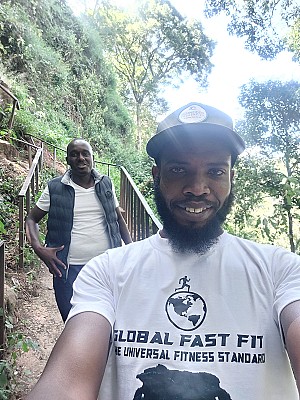
I Built a WhatsApp Bot for Women in Rural Kenya. I Cannot Code.
Dr. James Muchiri , Kenya Apr 06, 2026 1
Three AIs, zero coding background, one real product, and a lot more confusion than people imagine.
On April 5, 2026, a WhatsApp bot for women aged 30+ went live for our movement series in Nyandarua County, Kenya.
Women can register on WhatsApp, submit rope-skipping and fitness videos, get reminders, appear on leaderboards, and compete for monthly recognition. The bot stores data, syncs with Google Sheets, exports CSVs, supports admin review, and handles real-world messiness like incomplete submissions, wrong formats, and people typing greetings in the way people actually greet in Kenya.
I built it.
I still cannot sit here and pretend I am now a software engineer. I am not. A few weeks before this project, I could not have explained the difference between TypeScript and JavaScript in any useful way. I have no computer science background. I did not go to bootcamp. I am a doctor, a fitness builder, and a person who spends a lot of time thinking about real people in real places, not software abstractions.
And yet, somehow, I built a working WhatsApp bot.
Not alone. With three AI assistants: ChatGPT, Gemini, and Claude.
This is the honest version of how that happened.
Why this had to be on WhatsApp
The project itself was not random.
I have been working on community fitness and preventive health through Global Fast Fit. One of the ideas I cared about most was creating a practical movement platform for women aged 30 and above in Nyandarua. Monthly participation. Measurable activity. Real structure. Something that could become both a useful program and, eventually, a valuable fitness dataset grounded in African reality.
The obvious instinct is to build an app.
That makes sense if your users live inside app stores, stable internet, email logins, and endless phone storage.
That is not the world I was designing for.
In Nyandarua, WhatsApp is the real operating system. If I wanted this thing to live in people’s hands, not just in my imagination, it had to happen there. So the product became a WhatsApp bot that could handle registration, consent, submissions, verification, reminders, and leaderboards inside a tool people already use.
That was the idea.
Then came the tiny issue that I did not know how to code.
Phase 1: ChatGPT helped me think like a builder before I could build
The first serious work I did with ChatGPT was not “write me a bot.”
It was more like: help me think.
What data should I collect? What should count as a valid submission? How many rope-skipping videos per day is fair? Should GFF Standard be unlimited attempts? Should we use GFF Standard or GFF Shuttle for the movement series? What should happen if a video does not show the full body? What does consent need to cover? What fields are useful now, and what fields might become valuable later?
This part mattered more than I realized at the time.
Because for a product like this, the rules are the skeleton. If the rules are weak, the code is just a faster way to create confusion.
ChatGPT was strongest here. It helped me turn a rough idea into a system with logic. It helped define user flows, contest rules, admin commands, data fields, verification logic, storage thinking, monthly cycles, and all the small decisions that make the difference between “nice idea” and “working program.”
It also introduced me to the technology stack. Node.js. TypeScript. Express. Supabase. S3. Twilio. These were not familiar words to me then. ChatGPT explained them patiently, repeatedly, and sometimes like a person teaching a village chief how a post office works.
This was also where I think I did something right as a non-developer: I kept pressing on edge cases.
Not theoretical edge cases. Human ones.
What if two people share one phone?
What if someone keeps submitting until they get lucky?
What if the video is trimmed?
What if the bot becomes too complicated for a first-time user?
What if the scoring logic encourages the wrong behavior?
What if our perfect technical design is a terrible fit for Nyandarua reality?
That phase was slow, but it was good slow.
The weakness was that ChatGPT could sometimes become too architectural when I needed something more brutal and practical. I needed, “create this file, paste this, run this command.” Sometimes I got a blueprint for the city when I needed directions to the nearest spanner.
Still, if ChatGPT had a role in this project, it was the architect. It helped me design the bones.
Phase 2: Gemini entered when the machine started coughing smoke
Once the project moved from rules into actual code and deployment, the mood changed.
Now I was dealing with broken routes, webhook confusion, logs that looked like ancient curses, and that classic software experience where you have many moving parts and none of them are moving in the correct direction.
That is where Gemini became useful.
Gemini was better when I had something concrete and ugly in front of me. Error logs. Failing routes. Broken request flows. State issues. It was less interested in the philosophy of the product and more interested in what exactly was on fire.
One of the most annoying bugs was painfully small. I was dealing with a webhook path mismatch around /webhooks/twilio versus /webhook/twilio. One missing letter. Hours gone. That is software. You build a cathedral and then discover the door is painted on the wall.
Gemini was also helpful in the stretch where Twilio started feeling like a relationship that had run its course. We had designed around Twilio early on, but eventually I shifted toward Meta’s WhatsApp Cloud API. That switch was not elegant, and it definitely was not cheap in terms of energy, but it ended up being the right move.
Another hard area was session state. The bot would lose the plot between messages. A user would answer question three and the bot would behave like it had never met her. We kept circling that until the idea of explicit user state became clearer to me: where is this person in the flow, what did they already submit, what is the next expected thing?
That sounds obvious when written neatly in a blog post. It did not feel obvious at midnight with a broken bot.
If ChatGPT helped me think in systems, Gemini helped me respect logs. That may actually be one of the biggest lessons of this whole project. People talk about prompting. Fine. Prompting matters. But log reading matters more. Once I learned to copy the exact error, not paraphrase it, not soften it, just paste it as-is, the AIs became dramatically more useful.
Phase 3: Claude came in when I needed a builder, not a philosopher
By the time I moved heavily into Claude, the project had history, scars, and fragments everywhere.
There were handover notes. There was partial code. There were missing pieces. There were earlier design decisions that no longer matched the infrastructure. There was at least one machine continuity problem. And there was that feeling every messy project gets, where some of it lives in the codebase, some of it lives in your head, and some of it lives nowhere at all.
Claude was strongest when the task became: inspect this thing, compare it to the spec, identify what is broken, and systematically work through the gaps.
That mode suited the project.
One of the biggest practical breakthroughs came around message handling and Meta integration. At one stage the bot could receive messages but could not send them properly. At another stage menu routing was wrong enough that users could get pushed back into the wrong path. There were also infrastructure headaches that had nothing to do with my intelligence or Claude’s intelligence and everything to do with the fact that Meta can be absurd.
I want to be very clear about that. Some parts were not “hard because I am a beginner.” They were hard because the platform itself was chaotic.
We had cases where a number looked present in the dashboard but behaved like it did not exist at the API layer. That is not a poetic failure of the human spirit. That is just platform nonsense.
Still, Claude was helpful in systematically untangling those parts. It was closer to a builder or auditor. Less “let’s brainstorm” and more “here are the violations, here is the sequence, now fix them.”
That mattered, because by then I needed momentum more than inspiration.
The hardest part was not coding
I know that sounds like a trick line, but it is true.
The hardest part was continuity.
That is the thing people do not understand when they fantasize about building with AI. They imagine you open a chat window, say “build my product,” and receive software like takeaway food.
That is not what happened.
What happened was that the project lived across multiple AIs, changing stack decisions, handover notes, a crash or at least a broken environment, and my own evolving understanding of what I was trying to build.
Every time I switched AI, I gained a fresh pair of eyes and lost context.
Every time I updated the architecture, I solved one problem and created documentation debt somewhere else.
Every time the machine failed or the environment changed, I was reminded that a system can be real in six places and still feel missing.
That was the hardest part. Not syntax. Coherence.
In hindsight, if I had done one thing better, it would have been this: maintain a brutal running document of what works, what is broken, what changed, what the current stack is, and what the next step is. Not a beautiful document. A war diary.
Because without that, building with multiple AIs starts to feel like running three relay races on three different tracks while carrying the same baton in your teeth.
What I think I did well, despite not being a developer
I was not bringing coding skill to the table. So the question is: what was I bringing?
A few things, I think.
First, I knew the users.
That sounds small, but it is not. The AI did not know Nyandarua women. The AI did not know what it means to build for people who are not living in product-demo land. The AI did not know what a confusing prompt feels like to a first-time user, or why a WhatsApp-native flow matters, or why asking for the wrong thing at the wrong moment makes the whole system feel alien.
I kept dragging the project back to real life. That was one of my main jobs.
Second, I was stubborn about logic.
I did not accept “it should work.” I kept asking, how exactly? What happens next? What if the video is wrong? What if the user goes silent? What if the same person tries again? What counts as fair? What breaks comparability? What data is worth collecting and what data is just decoration?
That helped.
Third, I got better at giving raw material instead of vague feelings.
When something broke, I learned to paste the exact error. The exact route. The exact response. The exact strange behavior. AI is much worse with “it’s not working” than with “here is the log, here is the request, here is what happened.”
I am convinced that this was one of the most important skills I developed.
What I did badly
Plenty.
I let version 1 stay liquid for too long. I was trying to think about the future, the dataset, the scale, the architecture, the monetization, the wider movement, and the immediate bug all at once. Vision is good. Too much simultaneous vision becomes fog.
I also switched contexts a lot. Sometimes that was necessary. Sometimes it was just expensive.
And like many non-developers, I occasionally wanted the answer to be conceptual when the truth was painfully local: wrong route, wrong token, wrong variable, wrong state, wrong order of operations.
Software is humbling in that way. It does not care that your idea is noble. It wants the right character in the right place.
The most memorable moment
There were a few.
The funniest category of moments was when the bug was microscopic and the suffering was enormous. A wrong path. A missing assumption. A state mismatch. That happened more than once.
The most frustrating moments were definitely around Meta. Fighting an API that behaves like it is gaslighting you is a special form of modern pain.
But the best moment was simple: the bot replying for real.
Not in theory. Not in a sandbox. Not in a document. Not in a handover plan. Actually replying.
That moment mattered because until then the project was a swarm of ideas, specs, logs, rewrites, and stubbornness. After that, it was a thing.
A real thing.
What I learned from using three AIs
ChatGPT was best for product design, architecture, structure, and forcing me to think clearly.
Gemini was best when I needed a mechanic, when the machine was already broken and I needed someone to stare at the ugly parts with me.
Claude was strongest when the task was systematic execution against a spec.
So yes, the AIs felt different. Not magical, just different. Different habits of thought. Different styles of usefulness.
But the larger lesson is that none of them could replace judgment.
They could generate code. They could explain concepts. They could debug. They could suggest architecture. What they could not do by themselves was care about the actual women this product was for, or decide what kind of experience made sense in this context, or hold the whole mission steady when the tooling got chaotic.
That part was still mine.
What I would tell another non-developer trying this
Start with the rules. Before you ask for code, define the real system.
Keep a running project diary. Every day. What works, what broke, what changed, what is next.
Copy exact errors. Exact logs. Exact routes. Exact outputs.
Freeze version 1 earlier than your ego wants to.
Do not confuse “big vision” with “current step.”
And most importantly, know your users better than the AI does. That is your leverage. The AI can generate the scaffolding. You have to make sure the building belongs in the neighborhood.
The honest conclusion
This project was not a clean triumph. It was not smooth, elegant, or cinematic.
It was fragmented. It was frustrating. It involved loops, rewrites, false starts, handovers, platform nonsense, and the constant feeling that the project might scatter if I stopped holding it together.
But it worked.
That matters to me.
Because on the other side of all the technical confusion is something very simple: women in Nyandarua can now use a familiar tool to join a structured fitness competition, submit performances, and be part of something larger than a spreadsheet or a speech.
And I got there without becoming a traditional developer first.
I got there by combining obsession with the problem, patience with the process, and three AIs that each helped in different ways.
So no, I cannot code in the normal sense.
But I have now shipped software.
That sentence still feels strange in my mouth. But there it is.
Medicine of the Future
Dr. James Muchiri , Kenya Jan 04, 2026
The medicine of the future will not smell like antiseptic or sound like monitors. It will sound like conversation. It will look like movement. It will feel suspiciously ordinary.
It will happen before anyone becomes a patient.
For a long time, medicine has been excellent at rescue. When the body collapses, we rush in with precision, protocols, and pharmaceuticals. This is heroic work. Necessary work. But rescue is not the same as care, and it is certainly not the same as prevention.
The future of medicine begins upstream.
It begins in how people move their bodies daily, not once a year on a hospital bed. It begins in whether communities feel seen, connected, and competent. It begins in whether health is something people do together or something done to them.
In that future, exercise is not a punishment for being overweight. It is a social ritual. A reason to gather at dawn. A shared language that needs no translation. Functional movement becomes medicine because it restores what modern life quietly erodes: strength, balance, confidence, agency.
Measurement still matters, but it changes character. Blood pressure, waist circumference, pulse, trends over time. Collected calmly, without drama. Not to label people as sick, but to notice when the body whispers before it screams.
The clinic walls soften. Some of the most important consultations happen over a chessboard, a table tennis rally, a shared walk, a cup of coffee. Cognitive health is not separated from physical health. Mental wellbeing is not outsourced to crisis moments. Belonging becomes a clinical intervention.
Technology plays a role, but not as spectacle. Artificial intelligence in the future of medicine is quiet, respectful, and useful. It lowers barriers instead of raising them. It helps people ask better questions about their own lives. It assists communities to organize, learn, and adapt without surrendering privacy or dignity. AI becomes a bicycle for health, not a replacement for human judgment.
Importantly, the medicine of the future is local before it is global. It is designed with communities, not dropped into them. It recognizes that behavior changes faster when people see themselves in the solution. When health feels like something owned, not prescribed.
Hospitals will still be there. Drugs will still save lives. Surgery will still be miraculous. But the center of gravity shifts.
The most powerful medicine of the future is time. Time spent moving. Time spent together. Time spent paying attention early. Time spent building systems that reward consistency instead of crisis.
The future doctor looks less like a gatekeeper and more like a systems designer. Someone who understands bodies, yes, but also environments, habits, incentives, and culture. Someone who knows that the strongest prescription is often not written on paper.
Medicine of the future does not wait for disease to announce itself.
It meets people where they are, helps them move forward together, and quietly makes illness less likely in the first place.
And when it works, almost no one notices.
Which is exactly the point.
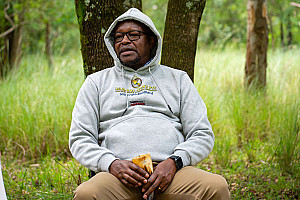
Muratina
Dr. James Muchiri , Kenya Dec 15, 2025
In the earlier piece on ngemi, I explored how ululations were used to announce a birth and to publicly declare the virtues a child was expected to grow into. Ngemi was immediate, audible, and communal. It travelled quickly, carrying news and expectation across space.
But among the Agīkūyū, celebration did not end with sound.
Once the ululations settled, the gathering shifted. The focus moved from announcement to responsibility. This transition is where muratina traditionally appeared.
If ngemi spoke to the wider community, muratina addressed those who would carry the responsibility forward.
Muratina in Context
Muratina (mũratina) is a traditional fermented drink named after the mũratina tree (Kigelia africana), whose fruit is used in the brewing process. While often described simply as alcohol, culturally muratina was not brewed or consumed casually.
According to traditional accounts, muratina was brewed for specific purposes: rites of passage, marriage-related ceremonies, reconciliation, councils of elders, and occasions involving blessing. A man did not brew muratina for private consumption. It was prepared with intent, for defined social moments.
Brewing itself was a communal activity. Younger family members assisted with harvesting and preparation, elderly women carried out the brewing, and elderly men presided over beer-related rituals. Brewing took place around the hearth in the woman’s hut, a space associated with solemn domestic and ritual functions.
Ingredients as Cultural Markers
Muratina was traditionally made using four core ingredients: water (maaĩ), sugarcane juice (ngogoyo), honey (ũũkĩ), and the mũratina fruit. Each ingredient had both a practical role and a culturally understood meaning.
Water (Maaĩ)
Water formed the base of the brew. Culturally, it was associated with purity, truth, righteousness, and self-control. Its adaptability — taking the shape of its container — was often used to illustrate how one should uphold truth while adjusting to circumstances.
Sugarcane Juice (Ngogoyo)
Sugarcane juice provided fermentable sugars. Its segmented structure informed its symbolism. The less sweet upper segments represented youth and inexperience, while the sweeter lower segments represented maturity and wisdom. Different sugarcane varieties were also used to illustrate learning from multiple sources.
Honey (Ũũkĩ)
Honey symbolized hard work, wealth, and collective identity. Bees were frequently referenced as models of social organization: working in colonies, defending only when necessary, returning to their hive, and extracting value even from difficult environments. Honey reinforced ideas of cooperation, discipline, and responsibility to one’s community.
Mũratina Fruit
The sausage fruit was not picked from the tree; it was used only after falling naturally. This was understood to represent maturity and natural readiness. The many seeds inside the fruit symbolized fertility, posterity, and continuity. Traditional belief also associated the fruit with strength and vitality into old age.
Preparation, Vessels, and Rules of Use
Muratina was brewed in large gourds known as ndua and served from medium-sized gourds called nyanja. Men and women used different drinking vessels, reflecting established social roles.
Consumption followed clear rules:
-
Muratina was shared, not portioned
-
The order of drinking mattered
-
Elders drank first because they were expected to speak, bless, or decide
Refusing to drink muratina was acceptable. Disrespecting the process was not.
During significant occasions, muratina was also used for blessing. A small amount might be poured onto the ground for ancestors, and a little applied to the hands or chest before words of blessing were spoken. Through this, muratina was understood to connect the unborn, the living, and the ancestors, with Ngai as witness.
Parting Shot.
Understanding muratina only as a traditional alcoholic drink misses its primary cultural role. It functioned as a structured social tool, governed by rules, symbolism, and purpose.
After the ululations had done their work, muratina ensured that celebration was followed by reflection, and that spoken blessings were anchored in collective responsibility.
In this way, muratina did not replace ngemi.
It completed it.
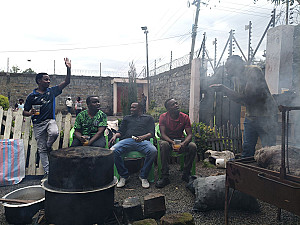
The Original Gender Reveal
Dr. James Muchiri , Kenya Nov 11, 2025
(Dedicated to the little warriors whose cry called us to ululate once more.)
We recently gathered in a friend’s house for one of those beautiful men’s moments — laughter, stories, and that quiet pride that fills the air when one of us becomes a father.
There was music, warmth, and, of course, muratina — that sacred nectar that turns ordinary talk into the kind of wisdom that only makes sense when the gourd has gone halfway down.
And somewhere between the laughter and the sip, it struck me — how beautiful the original gender reveal used to be.
Before the Balloons and the Powder
Today, gender reveals are an explosion of pink and blue. Cakes hide secrets, balloons burst into confetti, and someone always catches it all on camera. It’s fun, dramatic, even spectacular.
But before the colors, before the cameras and countdowns, our people had their own way.
They didn’t use balloons — they used breath.
They didn’t need fireworks — they had voices.
When a child was born, the community didn’t wait for a post — they listened.
If you heard four ululations, a girl had arrived.
If you heard five, a boy had been born.
But those ululations — ngemi — were not just about gender.
They were blessings sung through rhythm, virtues spoken in sound.
Four for the Girl
The girl’s four ululations, ngemi inya cia kairitu, formed a complete circle — a song of balance.
Each sound carried a virtue:
-
Uthamaki – Leadership: The ability to govern oneself and others with fairness and grace.
-
Ugo – Healing: The power to mend — to restore harmony in body, spirit, and community.
-
Urathi – Prophetic Insight: The divine ability to see beyond the visible — to discern seasons and speak truth before it unfolds.
-
Utonga – Wealth: Abundance of spirit and substance — the capacity to create, sustain, and share life.
The four ululations formed the full measure of inner strength — completeness, balance, and harmony.
Five for the Boy
The boy’s ngemi ithano cia kahii carried the same four virtues, but added a fifth — the one that sent him beyond the walls of home.
-
Ucamba – Bravery: Courage, endurance, and the will to defend what is right and true.
That fifth ululation was the outward call — to protect, to explore, to build, and to extend the legacy.
To the Little Warriors
And so, to the little warriors — within and beyond the Global Fast Fit circle — whose coming stirred our hearts:
Go forth, be a Prophet — bring light to your generation.
Go forth, be a King — govern with fairness and humility.
Go forth, be a Healer — mend what is broken in body and spirit.
Go forth, be a Wise Man — preserve harmony through understanding.
Go forth, be a Warrior — stand firm, protect, and lead with courage.
Five ululations were sounded for you — not just to announce your birth, but to proclaim your destiny.
The Beauty of the Old Ways
When I think of today’s gender reveals — the confetti, the colored smoke, the cheers — I smile. They’re joyous, yes, but they only reveal what the child is.
Our ancestors revealed who the child was meant to become.
They didn’t say, “It’s a boy” or “It’s a girl.”
They said, Here comes one who will lead, think wisely, see truly, prosper deeply, and stand bravely.
That was the original gender reveal — not of color, but of character.
And as for the muratina — that story deserves its own day.
I’ll tell you about it next time.
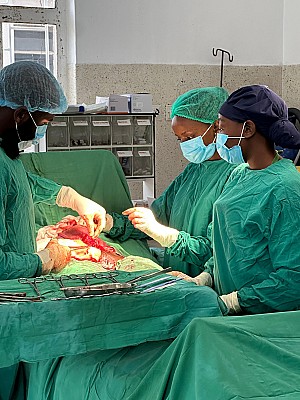
Gratitude
Dr. James Muchiri , Kenya Oct 06, 2025 1
Someone asked me the other day what my most valued trait is. Without hesitation, I said gratitude. That answer wasn’t born on a poster or inside a self-help book; it came out of a season that felt like a long, badly told joke.
I was a medical superintendent with an impressive title but no salary. For twelve months I worked without pay because I’d found myself on the wrong side of a tumbocratic county administration — and apparently, I needed to be “taught some manners.” My wallet had a Do Not Resuscitate order, yet my phone still lit up with wedding, funeral, and graduation committee requests. They weren’t bad people or greedy groups; those committees were part of the fabric of the community. It was only the timing that was off — their optimism about my contribution collided head-on with my empty bank account. I’d laugh when the messages came in because there was nothing they could extract from me. On their spreadsheets, my contribution must have read “thoughts and prayers.” That was my dark comedy channel at the time, and somehow it kept me sane.
Looking back now, I can see what was happening. My psychiatry teacher, Dr. Atwoli, used to tell us that depression is when life literally loses its colour and turns black and white. At the time I didn’t realise that was exactly what I was slipping into. It didn’t happen suddenly; it was gradual. Days that had once felt normal became dull. Food tasted flat. Music turned into noise. I still went to work, still signed charts, still cracked the odd joke — but I wasn’t really there.
It’s very much like the old frog fable: if you put a frog in boiling water it jumps straight out. But if you put it in cool water and slowly heat it up, it stays until it’s cooked because it doesn’t notice the danger. Depression works the same way. The “water” warms so gently you hardly notice. You just keep functioning while losing more and more of yourself. Sometimes you get out early. Other times you get out just in time. Looking back, that was me — still doing my job, still appearing “fine” on the outside, but quietly shrinking inside without realising it.
To cope, I withdrew. Isolation became my shield. The weight crept on and I slowly lost touch with who I was. My world shrank to work and walls. Solitude is tricky: at first it feels like safety, a quiet place where no one can demand anything from you. But over time it starts to bend you. With no outside voices, you lose perspective; you start replaying the same thoughts over and over until they harden into truths. Days blur into each other. Small problems feel huge. Your confidence shrinks because there’s no feedback except your own self-criticism. Yet there’s another side to it too. In the middle of all that stillness, once the noise dies down, uncomfortable truths get loud. You start to see patterns — in yourself, in others, in your environment — that you were too busy to notice before. Solitude can damage you if you stay in it too long, but it can also act like a mirror if you use it carefully. That’s what happened to me. My brain, which had felt dulled for months, started to feel like a tool again — rusty, yes, but still capable of being sharpened if I could just start using it differently.
One morning, I made a decision: “I must be more generous.” I had no money to give, but I still had knowledge. So I posted a simple WhatsApp status: “Free health consultations.”
The sheer volume of calls that streamed in was unbelievable. Each story was a rollercoaster — some heartbreaking, some hilarious, some unexpectedly beautiful. By evening I was tired in a clean way — the kind of fatigue that feels earned. And it hit me: even at my “rock bottom,” there were people living beneath it. That’s when I made the second resolution: be more grateful.
I kept going, then scaled to once a week before compassion burnout could sneak in wearing a friendly face. The strange alchemy of giving took hold: I offered what I knew, and it returned as something I had forgotten — relevance, connection, the sensation of being placed correctly on the map. Gratitude changed my posture. It didn’t fix the arrears; it fixed my angle toward the light.
At around that time, I reconnected with John Groom — the founder of Global Fast Fit. John is young for his age, a bundle of bright contradictions: methodical yet with a streak of stubbornness, a perfectionist, stylish, intelligent, relentless. He’s blunt enough to spare you confusion, precise enough to save you time. He dresses like calendars are watching and speaks with the tensile clarity of someone who has argued with first principles and won. He could take an ordinary conversation and turn it into a strategy session, then pivot and make you laugh in the same breath.
Years earlier, while I was still on campus, he had given me a job. That moment felt like a direct payoff from my childhood. As a young boy my father and I would sit with Brighter Grammar books, line by line. He emphasised the importance of good communication and clarity of thought, even when I was barely tall enough to see over the table. Those sessions built habits that later helped me write, speak and present myself — and those same skills opened the door to that first job with John Groom.
I looked up to John — not in the worshipful way that melts accountability, but in the respectful way that sharpens it. He travelled widely, lived boldly, and carried himself as though life itself was a canvas to be painted on his terms. Being around him made you want to step into a bigger version of yourself.
The journey with him has been transformative, not because it erased my struggles, but because it reframed them and showed me what could be built from them.
I’m exercising more. I’m learning table tennis. I’m working in a challenging but stimulating role as a medical consultant and regional manager for Global Fast Fit. I’m eating healthier. These small changes are building a very different daily rhythm from the one I had at rock bottom. They’re not dramatic, but they’re steady, and together they’re giving me back energy, confidence and purpose.
I’m still human. Some mornings I’m trying to be a functional adult and forgetting how. Some afternoons old habits win. But more often the direction is forward. The work is making sense. The coat is lighter. Becoming the Doctor of Free isn’t draining me; it’s giving me back purpose.
I’m still recommending rest, water, movement and a short list of medicines. But I’m also quietly prescribing the things saving me: clarity, gratitude and usefulness. They’re free, non-addictive and the refills are unlimited.
The brain is remarkable. It can break in complicated ways, but it can also repair itself while still working. That’s the gift I’m learning to appreciate. Mine isn’t perfect, but it’s sharper now and it’s remembering what it’s for.
Have a gratitude-filled October! Won’t you?
Holy Heavyweights
Dr. James Muchiri , Kenya May 07, 2025
Imagine a contest where the Bible’s strongest, fastest, and most enduring heroes compete head-to-head in a modern GFF Challenge: 30 push-ups, 30 squats, 30 leg lifts, and a 500-meter run. Using current world record exercise speeds and legendary (or plausible) animal speeds for the run, here’s how these iconic figures might compare.
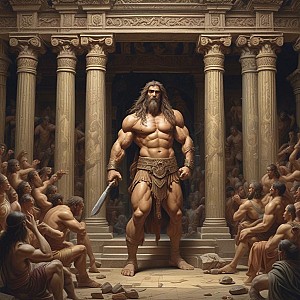
Samson; Judge and Nazirite Strongman; 1:20 (Estimated)
Samson’s legendary strength is unmatched in scripture—tearing apart a lion, carrying city gates, and defeating armies single-handedly. While the Bible doesn’t describe his running speed, his explosive power and stamina would be off the charts. If Samson could perform each exercise in just 10 seconds and run 500 meters in 20 seconds—reflecting his miraculous abilities—he would finish the GFF challenge in approximately 1 minute and 20 seconds, likely the fastest among mortals.
Asahel; Young Warrior; 1:31
Asahel is remembered for being “swift as a gazelle,” a title taken literally here. Using a gazelle’s sprint speed for the 500-meter run (22.5 seconds) and world record times for the exercises, Asahel’s total GFF score would be 1 minute and 31 seconds, putting him among the speediest men of the Bible.
David; Young Shepherd/Warrior; 1:31
David, famed for his agility and strength—able to take on lions, bears, and giants—was compared to a deer for his speed. With a deer’s top speed for the run and elite times for the exercises, David would also complete the GFF challenge in 1 minute and 31 seconds, tying Asahel and proving his legendary athleticism.
Goliath; Veteran Philistine Champion; 2:00 (Estimated)
Goliath was described as a giant, towering over his opponents and feared for his raw power. His massive size likely gave him immense strength but limited his speed and agility. If he could complete the exercises in 20 seconds each and run 500 meters in 60 seconds—a fast time for someone of his build—his GFF score would be about 2 minutes flat, showing overwhelming power but not quite matching the swiftest.
Jacob; Middle-aged Patriarch and Angel-Wrestler; 0:45 (During the Feat), 8:43 (After)
Jacob performed one of the Bible’s most extraordinary feats by wrestling an angel through the entire night, a contest that no ordinary human could survive, let alone endure. In that miraculous moment, Jacob’s strength, endurance, and resolve would have soared to superhuman levels—if channeled into the GFF challenge, he could have completed all exercises and the run in a staggering 45 seconds, outpacing even the fastest mortals by a wide margin. However, the cost of this divine encounter was a dislocated hip, and after the struggle, Jacob’s physical abilities were drastically reduced; his post-fight GFF score would plummet to 8 minutes and 43 seconds, showing both the peak of his miraculous potential and the lasting impact of wrestling with the divine.
Saul; Grown King; 1:45
Saul, described as “swifter than eagles,” was tall, strong, and a formidable leader in battle. Matching an eagle’s flying speed for his 500-meter run (36 seconds) and using elite exercise times, Saul would complete the GFF challenge in 1 minute and 45 seconds, earning a place among the biblical elite.
Jonathan; Young Prince; 1:45
Jonathan, Saul’s son, was also praised for his speed and courage, often fighting at the front lines. With the same eagle comparison and athletic ability, Jonathan would match his father’s GFF score of 1 minute and 45 seconds, proving himself one of Israel’s finest warriors.
Caleb; Elderly Veteran (Age 85); 2:30
Caleb, at 85 years old, boldly claimed the hill country and drove out giants from Hebron. Even in old age, his faith and vigor were legendary. If we give him a strong but realistic veteran’s time—85 seconds for the 500-meter run and just above world record speeds for the exercises—Caleb would score about 2 minutes and 30 seconds. His performance would be remarkable for any age, and truly extraordinary for a man in his ninth decade.
These scores show that the Bible’s legendary figures, if placed in a modern fitness challenge, would still stand out for their unique strengths—whether speed, power, endurance, or sheer determination. Some, like Jacob, would even brush the edge of the miraculous.

Why I love my job as a General manager & medical consultant at Global Fast Fit.
Dr. James Muchiri , Kenya Sep 26, 2024 2
My name is Dr. James Muchiri, a medical doctor with a deep passion for primary healthcare. I come from a quiet village called Gatimu, nestled in Nyandarua County. Not many people often mention their primary school, but I always do—and for one special reason: it allows me to talk about my childhood inspiration, Mrs. Wahome.
Mrs. Wahome was an extraordinary woman, even by today's standards. She lived in Muthaiga and drove a sleek Peugeot 504. Always with a smile, she radiated warmth.
One day, after an English lesson, she signaled for me to follow her to the staffroom. I was terrified. The staffroom was a place where "hardcore" troublemakers were broken down by a group of underpaid and frustrated teachers, battling their own struggles with poverty and depression. But that’s a story for another day.
I was just 11 years old. Instead of the punishment I feared, Mrs. Wahome did something unexpected. She sat me down and talked to me about self-grooming and other basic life lessons. But it wasn’t what she said that stayed with me—it was how she said it, with love and genuine care. In that moment, she made an ADHD kid like me feel seen and valued.
That moment has had a lasting impact on me, and it’s part of what drives me today in my work as the link between Global Fast Fit and communities in Kenya. Our primary focus is disease prevention through exercise, helping people stay healthy and active.
The second mission is uplifting communities—sending children to school, paying their fees, providing uniforms and books, and even connecting them with mentors.
Now, back to my beloved teacher. When I received my first paycheck as a doctor, the first thing I did was search for Mrs. Wahome. When I found her, I asked how I could repay her for the impact she had on my life. With the same grace she had shown years ago, she told me, "When good is done to you, sometimes it’s not about returning it, but extending it to the next person."

The ADHD Doctor.
Dr. James Muchiri , Kenya Jul 22, 2024 2
I love psychiatry for a variety of reasons. Firstly, I had the previledge of sitting throgh lectures by two darlings; Prof Atwoli and Prof Gakinya. Both professors have a wonderful teaching method. They give real world scenarios and leave you to figure out the rest of the details. They paint the bigger picture and leave you to fish for the details from whichever 'pond' you so wish. Beyond the lecture room each has unique qualities. Prof Atwoli is a decent chess player and a brilliant writer with a CV the size of John's Chest. Prof Gakinya on the other hand is a man with a golden heart. Secondly, this is where I got a better understanding of myself.
Today I will tell you how I knew I had ADHD. It was through a patient we saw at the psychiatric clinic with Prof Gakinya.
In medical school we do a salad of courses. From First year to third year we do theory courses. These are termed basic sciences and they set the foundation for clinical rotations that happen for the rest of the duration in medical school. That is from fourth year to sixth year.
During the psychiatric rotation we had the pleasure of seeing a kid with ADHD with the good professor. As usual he asked us to observe the kid for sometime and come up with a diagnosis. The kid was all over the place; checking out our stethoscopes, perusing through our books, asking a million questions, climbing onto desks and a myriad of other activities. His classteacher had recommended a psychiatric review because the kid was mischevious, never seemed to ever pay attention in class, was never on time and almost always never completed his assignments. His school bag had several dog eared books with jumbled up books. It was not easy to make head or tail of the notes the kid had made.
We were still green if the field of psychiatry and it came as no surprise that each of one of us avoided eye contact with the prof when the time came for us to diagnose the kid. The prof made the diagnosis and went on to describe similar cases of ADHD he had come across in his practice.
This was a deja vu moment for me. I saw myself in that kid. Always late for school, dishevelled, disorganized, absent minded, hyperactive and a myriad of other traits. I took special interest in the subject and did extensive research. I definitely had ADHD that had been undiagnosed till I was in my twenities. My childhood now made sense.
to be continued...